Choose the right starting point.
Find a way to bring AI into a physical project. Start with the job you want it to do, then compare the complete system.
Motion and sensor AI: Thingy:53, Nano Sense Rev2 or Nicla Sense ME? →Raspberry Pi AI Camera
Start here for a single camera using a supported detection or pose model. Inference happens inside the Sony sensor, leaving the Pi to interpret results and run your application. Our first build reports whether a workbench pose is present.
Choose AI HAT+ when your required network is supported by Hailo but will not fit the IMX500 pipeline. Choose Jetson for a flexible GPU application. Check model conversion before buying either accelerator.
Hardware facts link to manufacturer documentation. Build fit is our editorial assessment. The linked hardware experiments are still unrun; synthetic code checks do not establish accuracy, speed, battery life or reliability on these devices.
Compare the whole build
Choose two products, or add a third. On a small screen, swipe across the table.
| What matters | 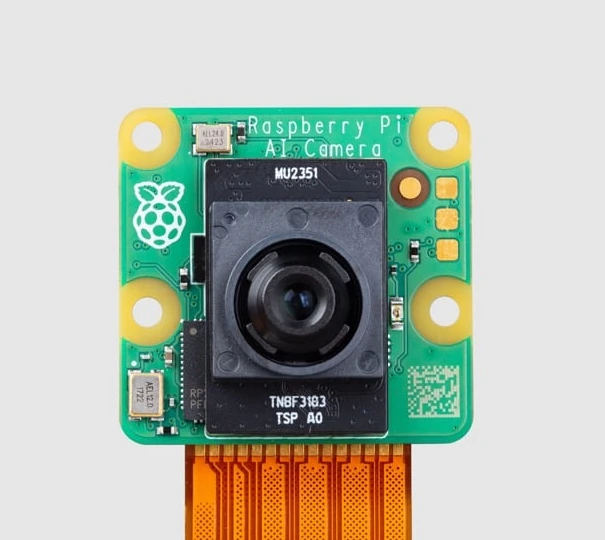 Raspberry Pi AI Camera ↗Full specificationsEstimate my cost → | 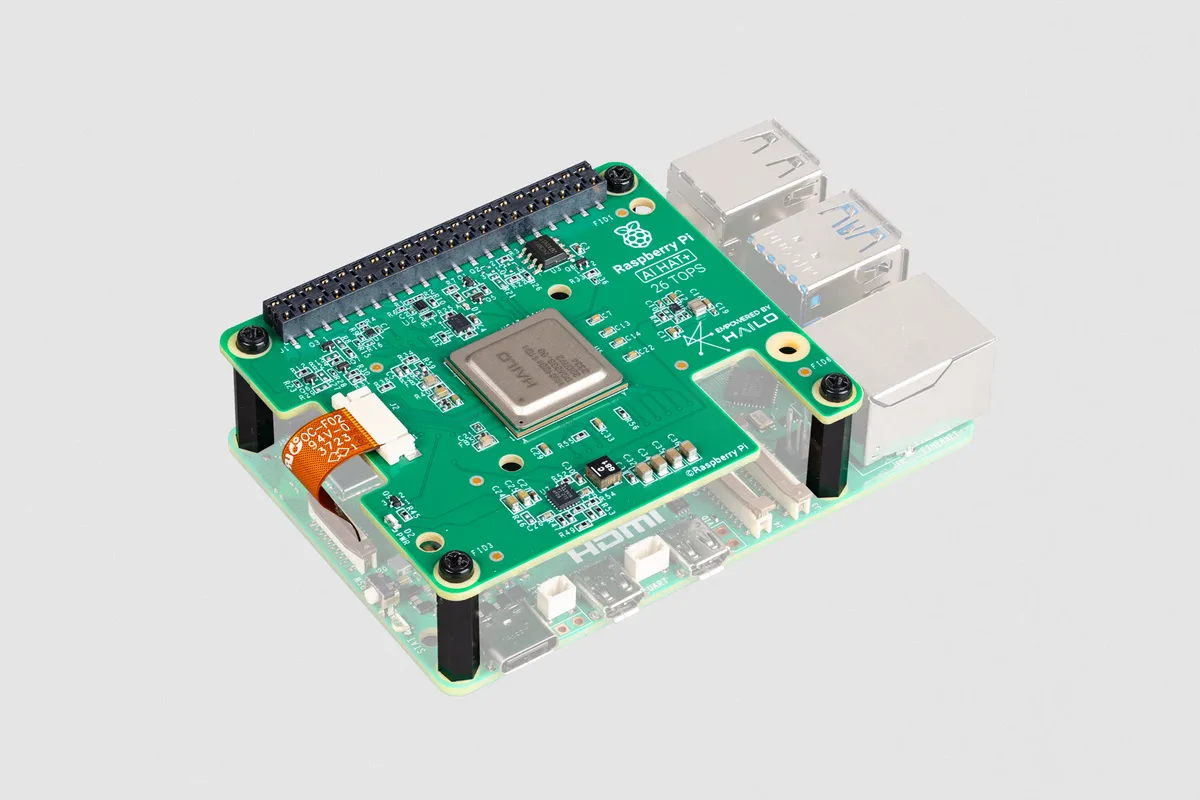 Raspberry Pi AI HAT+ ↗Full specificationsEstimate my cost → |
|---|---|---|
| Who it suits | Start here for a single camera using a supported detection or pose model. Inference happens inside the Sony sensor, leaving the Pi to interpret results and run your application. Our first build reports whether a workbench pose is present. | Start here for a Pi 5 camera pipeline that needs a supported Hailo vision network and host-side tracking or counting. The accelerator handles inference while the Pi can maintain track IDs and apply a crossing-line rule. |
| What you can build first | Proposed first result: a workbench presence indicator driven by a supplied pose model, with an “unknown” state when observations are stale or blocked. Later ideas include an interactive installation or object-presence log. The camera supplies model outputs; deciding when an event is meaningful remains your code. Manufacturer pose example | Proposed first result: count a bottle once when it crosses a line, then save the count and timestamp instead of a video archive. Later possibilities include pose-driven interfaces and separating a foreground object from its background. A bounding box alone is not a reliable counter: tracking, crossing direction and duplicate suppression are your application logic. Bottle-counting build |
| Device price | $70 manufacturer reference price for the AI Camera, without a Raspberry Pi host. This is a published reference, not a verified reseller checkout quote. Official AI Camera announcement | $70 for 13 TOPS or $110 for 26 TOPS, manufacturer reference prices for the original AI HAT+. Pi 5 and camera are separate. This is not the AI HAT+ 2. Official announcement |
| Other setup costs | Example new setup: Pi 5 2GB at the announced $77.50, plus a $40–70 editorial allowance for power supply, cooling, microSD and basic mounting. Choose more RAM if your host application needs it. Existing compatible Pi owners can reuse their setup. Pi 5 price update | Example host: Pi 5 2GB at announced $77.50. Allow another $65–100 for a basic camera, correct cable, power, active cooling and microSD (editorial estimate). Higher-resolution cameras, larger RAM and an enclosure can increase this. Pi 5 price update |
| Subscriptions and usage | $0 required service-plan budget for a local supported-model camera pipeline. Custom model conversion, optional cloud training, hosted dashboards and remote storage can add separate costs; they are not included in this baseline. | $0 required service-plan budget for the proposed local object counter using a supported Hailo model. Optional model-training services, paid development support, remote hosting or cloud AI are separate. Free local execution does not make custom model conversion effortless. Local Hailo runtime |
| First-year build budget | Estimated $187.50–217.50 from scratch: $70 camera + $77.50 Pi 5 2GB + $40–70 extras + $0 service plan. If you already have a compatible, fully equipped Pi, the camera-only addition starts at the $70 reference price. Confirm reseller prices before ordering. | Estimated $212.50–247.50 for 13 TOPS, or $252.50–287.50 for 26 TOPS. Formula: $70/$110 HAT + $77.50 Pi + $65–100 vision accessories + $0 service plan. An equipped Pi 5 owner may only need the HAT and any missing camera/cooling parts. |
| Price basis and date | USD · Manufacturer reference prices · Checked 5 Nov 2026; reseller stock and checkout not verified. | USD · Manufacturer reference prices · Checked 5 Nov 2026; reseller checkout not verified. |
| Getting started and difficulty | Connect the correct camera ribbon, install the documented IMX500 packages and run a supplied model before attempting conversion. Confirm image framing and the corresponding inference output, then add a timeout to the presence rule. Basic Pi/Linux and Python skills are enough for the starting example; custom model quantization/export is a further learning step. Official guide | First install the supported Pi OS/Hailo stack and run a supplied detector with one clearly visible bottle. Confirm detections before writing any counter. Then log track IDs and line crossings; replay a short sequence against a manual count. You need terminal, Python and camera-setup skills. Custom model compilation is a separate, more demanding task. Official setup |
| Input and output | Camera frames → sensor inference → image plus output tensors sent to the Pi over CSI-2. The Pi still receives images; sensor inference does not make the system metadata-only. Signal path | Separate camera → Pi preprocessing → PCIe accelerator → detection output → Pi tracking and application logic. Detecting the same object in several frames is not the same as counting it once. |
| Where the model runs | Sony IMX500 runs inference; the Pi does application logic and post-processing. Network input and on-sensor memory constrain model choice. Image resolution is separate from model input resolution. Camera guide | Hailo-8L at 13 TOPS or Hailo-8 at 26 TOPS, paired with Raspberry Pi 5. These are INT8 accelerator ratings. Confirm the exact variant. Hardware specifications |
| Complete the setup | AI Camera + Raspberry Pi with a camera connector + matching ribbon cable + OS storage + power. The image sensor and manual-focus lens are included. Confirm the cable for your Pi model. | AI HAT+ + Raspberry Pi 5 + compatible camera + power supply + OS storage. Allow for cooling, PCIe connection and enclosure clearance. The HAT alone is not a computer or camera. |
| Path to a custom model | Start with an IMX500 model-zoo network and Picamera2 or rpicam-apps. Custom networks need Sony conversion/packaging and matching output decoding. A PyTorch file alone is not ready to deploy. | Raspberry Pi camera stack or Hailo pipelines. Use a matching compiled HEF model. Custom models require a supported Hailo compiler/model-zoo path, calibration data and compatible runtime versions. |
| Power and portability | The camera takes power from the Pi connection. Budget for the whole Pi system and camera. Lower host inference work is useful, but it does not establish a measured battery-life advantage. | Budget for Pi 5, accelerator, camera and cooling together. Sustained operation in an enclosure needs thermal testing. Accelerator TOPS alone does not tell you whole-system watts or latency. |
| First hardware test | Try your actual distance, lighting and subject size. Measure missed detections and time to a fresh result after startup. Simulate missing output so the application reports unknown instead of reusing an old detection. | Move the same object across a counting line repeatedly, reverse direction and introduce occlusion. Compare counts with manual ground truth. Log dropped frames, end-to-end delay and temperature over a sustained run. |
| When to choose another route | Choose AI HAT+ when your required network is supported by Hailo but will not fit the IMX500 pipeline. Choose Jetson for a flexible GPU application. Check model conversion before buying either accelerator. | Choose AI Camera for its integrated sensor and supported on-sensor pipeline, especially with an older Pi. Choose Jetson for local language models. This comparison covers the original AI HAT+, not AI HAT+ 2. |
Measure the application
For a counter, measure count error and delay. For a wearable, measure false triggers and current. For a language assistant, measure field accuracy and response time. TOPS ratings across different architectures, precision and sparsity settings do not answer those questions.
Price the complete setup
Include the host, sensors, storage, power supply, cooling, enclosure and model-development effort. A camera module, an accelerator board and a developer kit include different things. Check current regional prices with the makers before purchasing.
These can work together
A proposed robot could use Nano for motion events and Jetson for perception. A Pi can turn camera detections into dashboard events. Define timestamps, stale-data handling and the communication link before combining devices. Local inference still needs an explicit data-retention and network policy.