Compare Arduino Nicla Sense ME with Edge AI alternatives
Read orientation and environmental trends. Compare the complete setup, developer access and trade-offs before choosing your first build.
Motion and sensor AI: Thingy:53, Nano Sense Rev2 or Nicla Sense ME? →Arduino Nicla Sense ME
Best fit: an embedded maker integrating compact motion/orientation and environmental sensing into an object. Use Bosch sensor-hub outputs and small application rules first. Choose Nano for introductory motion/audio model training, or Thingy for a battery and enclosure in the box. Editorial assessment, not a tested ranking.
No onboard microphone or camera. CO2-equivalent is not direct CO2 measurement; choose a dedicated CO2 sensor for that job. Sensor-fusion APIs do not guarantee arbitrary custom-model deployment.
Hardware facts link to manufacturer documentation. Build fit is our editorial assessment. The linked hardware experiments are still unrun; synthetic code checks do not establish accuracy, speed, battery life or reliability on these devices.
Compare the whole build
Choose two products, or add a third. On a small screen, swipe across the table.
| What matters |  Arduino Nicla Sense ME ↗Full specificationsEstimate my cost → | 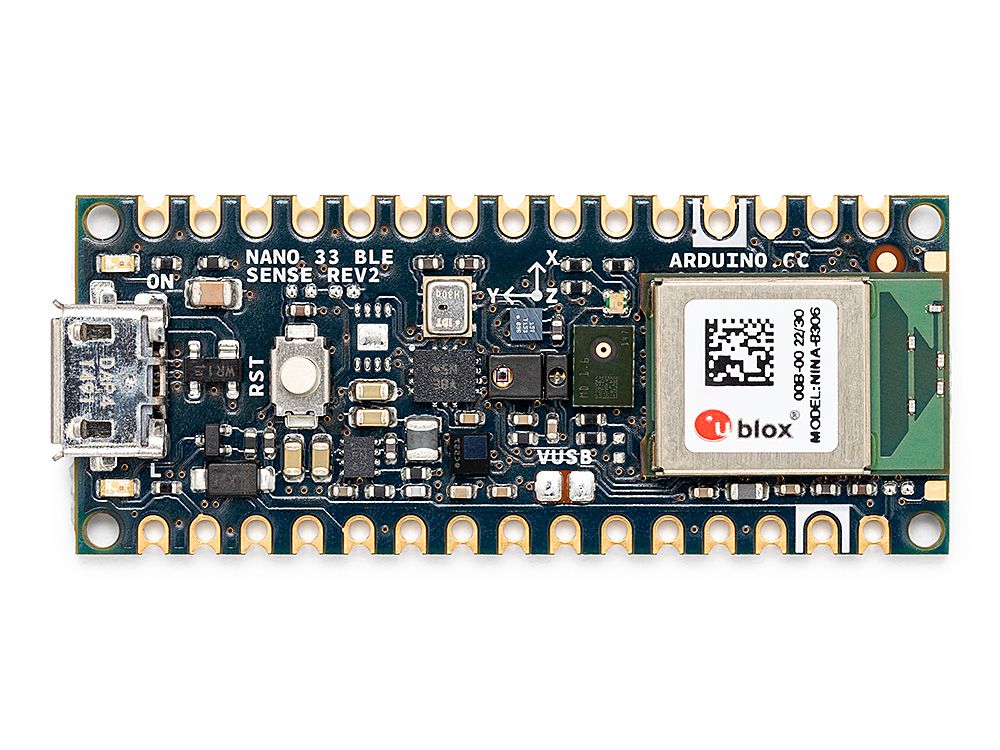 Arduino Nano 33 BLE Sense Rev2 ↗Full specificationsEstimate my cost → |
|---|---|---|
| Who it suits | Best fit: an embedded maker integrating compact motion/orientation and environmental sensing into an object. Use Bosch sensor-hub outputs and small application rules first. Choose Nano for introductory motion/audio model training, or Thingy for a battery and enclosure in the box. Editorial assessment, not a tested ranking. | Best fit: a learner or Arduino/C++ maker who wants to own the full small-model loop: collect motion or audio, train, export, modify the application and test a new wearer. Prefer Thingy:53 for an enclosed battery kit and phone-led first demo; prefer Nicla for Bosch sensor-hub outputs. This is an editorial assessment. |
| What you can build first | Proposed first result: turn a handheld object’s tilt into neutral, left, right or unknown states and show them over USB. Extend it into a motion logger or an environmental trend display. Start with a simple calibrated rule; it may solve the problem without model training. Tilt-controller build | Proposed first result: distinguish two deliberate hand gestures from ordinary movement, then print the result over USB. A wearable shortcut, toy controller or simple sound classifier can follow. Start with one input stream and include a reject class; a convincing training demo is not evidence it works for another person. Gesture build |
| Device price | US$34.58 sale · ABX00050; reference price $49.40. Official feed available=true on 14 Nov 2026; delivery unverified. US store | $39.70 with headers (ABX00070); $38.70 without headers (ABX00069). These are US Arduino Store prices, not a complete kit. With headers · Without headers |
| Other setup costs | US$10–25 editorial micro-USB cable and simple mount allowance. Reuse development computer/USB power. New computer, battery, enclosure, BLE receiver and custom-algorithm tools unquoted. | Allow $5–15 for a suitable data USB cable and basic bench accessories (editorial estimate). This gesture/sound prototype uses the onboard sensors and an existing computer. A battery, enclosure or extra sensors would be additional. |
| Subscriptions and usage | $0 required subscription for local sensor reading and rule logic. Optional cloud dashboard, APIs and advanced commercial toolchains are outside the starter subtotal; check their quotes/terms. | $0 subscription budget for the proposed local inference build. Training on your own computer avoids a hosted training bill. Optional paid cloud tooling, team plans and storage are outside this example; check their terms separately. Edge Impulse Developer is $0/month for individual exploration/prototyping; Enterprise pricing is separate. Tool pricing |
| First-year build budget | $44.58–59.58 = $34.58 board + $10–25 allowance + 12 × $0 required service, with existing computer/USB power. $34.58 if cable and mount are reused. Tax, shipping, electricity and labor excluded. | $44.70–54.70 = $39.70 ABX00070 + $5–15 cable/basic-mount allowance + 12 × $0 required service, with an existing computer/USB power. $39.70 if accessories are also reused. New computer and portable setup unquoted; tax, shipping, electricity and labor excluded. |
| Price basis and date | 14 Nov 2026 · USD · Arduino US listing and official product feed. Sale/availability may change; accessories are editorial allowances. | 14 Nov 2026 · USD · US Arduino listings. ABX00070 available=true in official feed; checkout/delivery unverified. Accessories are editorial allowances. |
| Getting started and difficulty | Moderate for reading sensors with basic Arduino/C++; advanced for custom sensor-hub algorithms (editorial assessment). Install Arduino Mbed OS Nicla Boards and Arduino_BHY2, then upload Standalone and inspect ShowSensorList over USB. Success is changing sensor values in Serial Monitor. Confirm the installed firmware exposes the required orientation/virtual sensor before adding tilt thresholds and dwell time. No cloud account is required for this first USB result. Official setup The learning work is sensor IDs, calibration, reference axes, mounting and FIFO/update timing. Add BLE after USB works. Deploying a custom model into BHI260AP is a separate firmware/toolchain/licensing task; the Arduino sensor API does not make it a generic TinyML deployment target. Sensor-hub developer guide | Moderate for an Arduino/C++ beginner; more work for reliable recognition (editorial assessment). Install Arduino Mbed OS Nano Boards and Arduino_BMI270_BMM150 for Rev2, then upload SimpleAccelerometer. Success is a changing three-axis stream in Serial Monitor as you move the board. A charge-only cable or Rev1 sensor library can prevent that first result. No cloud account is required for this USB sensor check. Official accelerometer example Then collect labeled windows, use the supported Edge Impulse Rev2 deployment route, and test an untouched recording session. Hosted training requires an account/internet; inference runs on the board. Expect to learn dataset design, model export, memory limits and reject-state logic before adding BLE. No hands-on setup duration is claimed. Rev2 deployment guide |
| Input and output | BHI260AP motion/fusion, BMM150 magnetometer, BMP390 pressure and BME688 environmental/gas sensing → USB/BLE readings or application events. Sensor APIs | Motion, microphone and environmental sensors → a class and confidence → GPIO or Bluetooth LE event. No built-in camera or Wi-Fi. Board documentation |
| Where the model runs | nRF52832 host application (64 KB RAM/512 KB flash shared with firmware) plus separate BHI260AP sensor-hub processing. Fused orientation is not automatically recognition of your intended gesture. Board manual | The nRF52840 microcontroller runs the model. 64 MHz Cortex-M4F, 256 KB RAM and 1 MB flash must hold your application, buffers and model. Datasheet |
| Complete the setup | ABX00050 board + micro-USB data cable + development computer and a stable mount. USB supplies the starter build. Battery, enclosure and a separate wireless receiver are optional later purchases. | Board + USB data cable + computer for programming and data collection. For a wearable, add a suitable power supply, mounting and enclosure. A Pi is not required. |
| Path to a custom model | Arduino_BHY2 exposes physical/virtual sensor outputs; start with Standalone and ShowSensorList. Custom BHI firmware, gas algorithms and their licenses require a separate assessment. Not a drop-in replacement for the Nano Edge Impulse workflow. | Arduino C/C++ and a TinyML deployment workflow such as Edge Impulse. Collect labelled sensor windows, train off-device, check memory use, then flash the classifier. Use the Rev2 IMU library. |
| Power and portability | Small board; a compatible battery and mounting/enclosure are extra. USB is sufficient for the first result. No measured battery endurance or current comparison is available. | A candidate for a compact sensor node. Battery life depends on sampling, inference, radio use and board configuration; measure current before choosing a battery. No battery-life result is available here. |
| First hardware test | Repeat left/neutral/right after remounting and near metal. Check calibration and missing/stale samples; compare simple thresholds against any proposed classifier before paying for advanced tooling. | Hold out an entire person or recording session. Test normal movement as well as intended gestures. Count false events per hour and missed gestures, then measure current with Bluetooth enabled. |
| When to choose another route | No onboard microphone or camera. CO2-equivalent is not direct CO2 measurement; choose a dedicated CO2 sensor for that job. Sensor-fusion APIs do not guarantee arbitrary custom-model deployment. | Choose a camera route for visual inspection. Choose Jetson for free-form language. A small sensor classifier does not understand arbitrary spoken instructions. |
Measure the application
For a counter, measure count error and delay. For a wearable, measure false triggers and current. For a language assistant, measure field accuracy and response time. TOPS ratings across different architectures, precision and sparsity settings do not answer those questions.
Price the complete setup
Include the host, sensors, storage, power supply, cooling, enclosure and model-development effort. A camera module, an accelerator board and a developer kit include different things. Check current regional prices with the makers before purchasing.
These can work together
A proposed robot could use Nano for motion events and Jetson for perception. A Pi can turn camera detections into dashboard events. Define timestamps, stale-data handling and the communication link before combining devices. Local inference still needs an explicit data-retention and network policy.