Compare HUSKYLENS 2 — TF Card Version (SEN0638-TF) with Edge AI alternatives
Standalone vision result, then controller output. Compare the complete setup, developer access and trade-offs before choosing your first build.
Motion and sensor AI: Thingy:53, Nano Sense Rev2 or Nicla Sense ME? →HUSKYLENS 2 — TF Card Version (SEN0638-TF)
For Arduino/ESP32 makers, educators and robotics builders who want vision results without first assembling a Linux camera stack. It is useful when an object label or position will drive a small rule. It is not evidence of production-quality defect detection, and its advertised TOPS figure does not establish application frame rate.
Choose OpenMV AE3 for a MicroPython-led sensor/control experiment if its supported model path suits you. Choose a Pi or Jetson when Linux libraries, broad model flexibility or multi-camera integration matter more than a self-contained touchscreen. HUSKYLENS is strongest when its built-in models or supported custom package format already cover your task.
Hardware facts link to manufacturer documentation. Build fit is our editorial assessment. The linked hardware experiments are still unrun; synthetic code checks do not establish accuracy, speed, battery life or reliability on these devices.
Compare the whole build
Choose two products, or add a third. On a small screen, swipe across the table.
| What matters |  HUSKYLENS 2 — TF Card Version (SEN0638-TF) ↗Full specificationsEstimate my cost → | 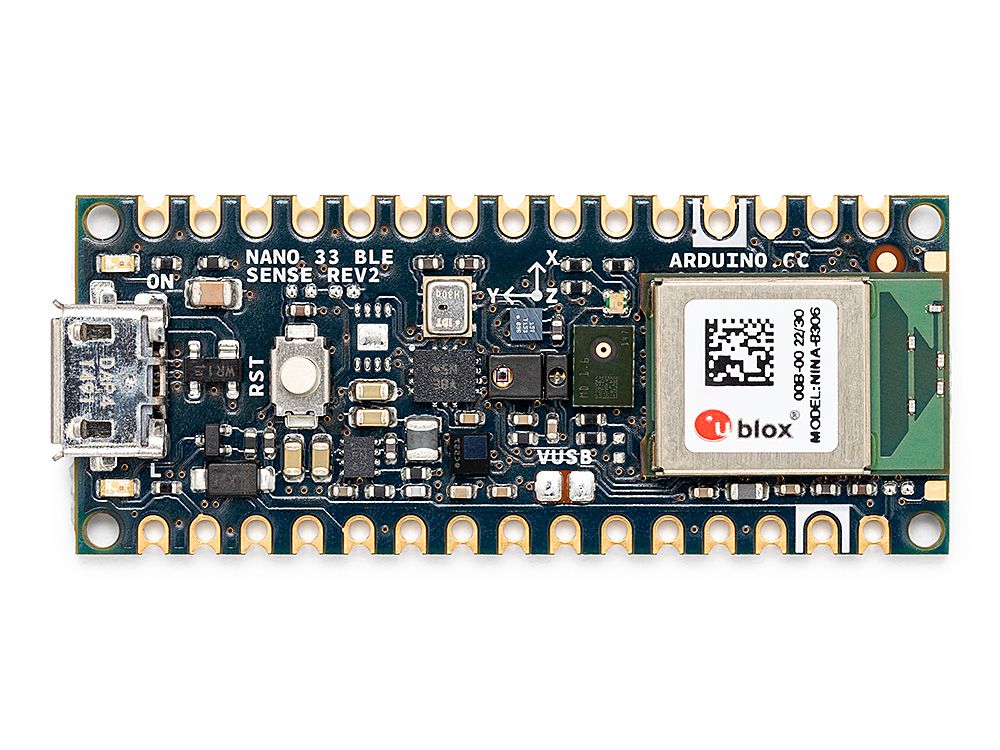 Arduino Nano 33 BLE Sense Rev2 ↗Full specificationsEstimate my cost → |
|---|---|---|
| Who it suits | For Arduino/ESP32 makers, educators and robotics builders who want vision results without first assembling a Linux camera stack. It is useful when an object label or position will drive a small rule. It is not evidence of production-quality defect detection, and its advertised TOPS figure does not establish application frame rate. | Best fit: a learner or Arduino/C++ maker who wants to own the full small-model loop: collect motion or audio, train, export, modify the application and test a new wearer. Prefer Thingy:53 for an enclosed battery kit and phone-led first demo; prefer Nicla for Bosch sensor-hub outputs. This is an editorial assessment. |
| What you can build first | Power the unit by USB-C, open a built-in vision function and show a fresh result on its own screen. A useful second step is learning a colored card and observing its identity as it moves through the frame. No host controller or cloud account is needed for the documented standalone screen demo. Then use the official controller library to print recognition IDs over UART or I²C before attaching an actuator. A custom parts counter and missing-component inspection station are proposed later builds requiring a labeled dataset and validation. Official first result · Build guide · Unrun tests | Proposed first result: distinguish two deliberate hand gestures from ordinary movement, then print the result over USB. A wearable shortcut, toy controller or simple sound classifier can follow. Start with one input stream and include a reject class; a convincing training demo is not evidence it works for another person. Gesture build |
| Device price | $89.90 SEN0638-TF | $39.70 with headers (ABX00070); $38.70 without headers (ABX00069). These are US Arduino Store prices, not a complete kit. With headers · Without headers |
| Other setup costs | USB cable/power; optional $7.90 Wi-Fi, controller, computer, actuator. | Allow $5–15 for a suitable data USB cable and basic bench accessories (editorial estimate). This gesture/sound prototype uses the onboard sensors and an existing computer. A battery, enclosure or extra sensors would be additional. |
| Subscriptions and usage | $0 required subscription for local recognition; optional training/cloud API extra. | $0 subscription budget for the proposed local inference build. Training on your own computer avoids a hosted training bill. Optional paid cloud tooling, team plans and storage are outside this example; check their terms separately. Edge Impulse Developer is $0/month for individual exploration/prototyping; Enterprise pricing is separate. Tool pricing |
| First-year build budget | $89.90 + missing power/cable; add controller/training/API costs for those extensions. | $44.70–54.70 = $39.70 ABX00070 + $5–15 cable/basic-mount allowance + 12 × $0 required service, with an existing computer/USB power. $39.70 if accessories are also reused. New computer and portable setup unquoted; tax, shipping, electricity and labor excluded. |
| Price basis and date | USD, official shop, 12 Nov 2026; excludes tax, shipping, electricity and labor. | 14 Nov 2026 · USD · US Arduino listings. ABX00070 available=true in official feed; checkout/delivery unverified. Accessories are editorial allowances. |
| Getting started and difficulty | Follow Getting Started for power, language and touchscreen selection, then Color Recognition for learning/settings. Begin with the screen result and change one variable at a time. For controller output, match I²C/UART settings and confirm IDs before adding control logic. Custom detection is a separate learning step: collect/annotate images, train a supported model, export ONNX, provide calibration data, generate a device package and install it. The official package generator requires Windows 10+ and .NET 7; its guide also links source for self-deployment, but another-OS workflow has not been validated here. Only specified nano architectures and 224/320/640 inputs are documented. Supported models and conversion workflow | Moderate for an Arduino/C++ beginner; more work for reliable recognition (editorial assessment). Install Arduino Mbed OS Nano Boards and Arduino_BMI270_BMM150 for Rev2, then upload SimpleAccelerometer. Success is a changing three-axis stream in Serial Monitor as you move the board. A charge-only cable or Rev1 sensor library can prevent that first result. No cloud account is required for this USB sensor check. Official accelerometer example Then collect labeled windows, use the supported Edge Impulse Rev2 deployment route, and test an untouched recording session. Hosted training requires an account/internet; inference runs on the board. Expect to learn dataset design, model export, memory limits and reject-state logic before adding BLE. No hands-on setup duration is claimed. Rev2 deployment guide |
| Input and output | Camera → local model → screen or UART/I²C results | Motion, microphone and environmental sensors → a class and confidence → GPIO or Bluetooth LE event. No built-in camera or Wi-Fi. Board documentation |
| Where the model runs | Supported vision inference on K230; training/packaging on external computer. | The nRF52840 microcontroller runs the model. 64 MHz Cortex-M4F, 256 KB RAM and 1 MB flash must hold your application, buffers and model. Datasheet |
| Complete the setup | TF-card sensor kit plus USB cable/power; controller and Wi-Fi are optional extensions. | Board + USB data cable + computer for programming and data collection. For a wearable, add a suitable power supply, mounting and enclosure. A Pi is not required. |
| Path to a custom model | Built-in models or supported nano-model ONNX package; Windows 10+ official generator. | Arduino C/C++ and a TinyML deployment workflow such as Edge Impulse. Collect labelled sensor windows, train off-device, check memory use, then flash the classifier. Use the Rev2 IMU library. |
| Power and portability | 3.3–5 V specified; USB-powered standalone unit. Stock unconfirmed. | A candidate for a compact sensor node. Battery life depends on sampling, inference, radio use and board configuration; measure current before choosing a battery. No battery-life result is available here. |
| First hardware test | Show one recognition result before training or adding actuators. | Hold out an entire person or recording session. Test normal movement as well as intended gestures. Count false events per hour and missed gestures, then measure current with Bluetooth enabled. |
| When to choose another route | Choose OpenMV AE3 for a MicroPython-led sensor/control experiment if its supported model path suits you. Choose a Pi or Jetson when Linux libraries, broad model flexibility or multi-camera integration matter more than a self-contained touchscreen. HUSKYLENS is strongest when its built-in models or supported custom package format already cover your task. | Choose a camera route for visual inspection. Choose Jetson for free-form language. A small sensor classifier does not understand arbitrary spoken instructions. |
Measure the application
For a counter, measure count error and delay. For a wearable, measure false triggers and current. For a language assistant, measure field accuracy and response time. TOPS ratings across different architectures, precision and sparsity settings do not answer those questions.
Price the complete setup
Include the host, sensors, storage, power supply, cooling, enclosure and model-development effort. A camera module, an accelerator board and a developer kit include different things. Check current regional prices with the makers before purchasing.
These can work together
A proposed robot could use Nano for motion events and Jetson for perception. A Pi can turn camera detections into dashboard events. Define timestamps, stale-data handling and the communication link before combining devices. Local inference still needs an explicit data-retention and network policy.