HUSKYLENS 2 — TF Card Version (SEN0638-TF)
See a recognition result on the built-in screen before adding a controller or training your own model. This $89.90 TF-card variant has a Windows-only official model-packaging step.
Illustrative sequence and routes; timing is not measured.
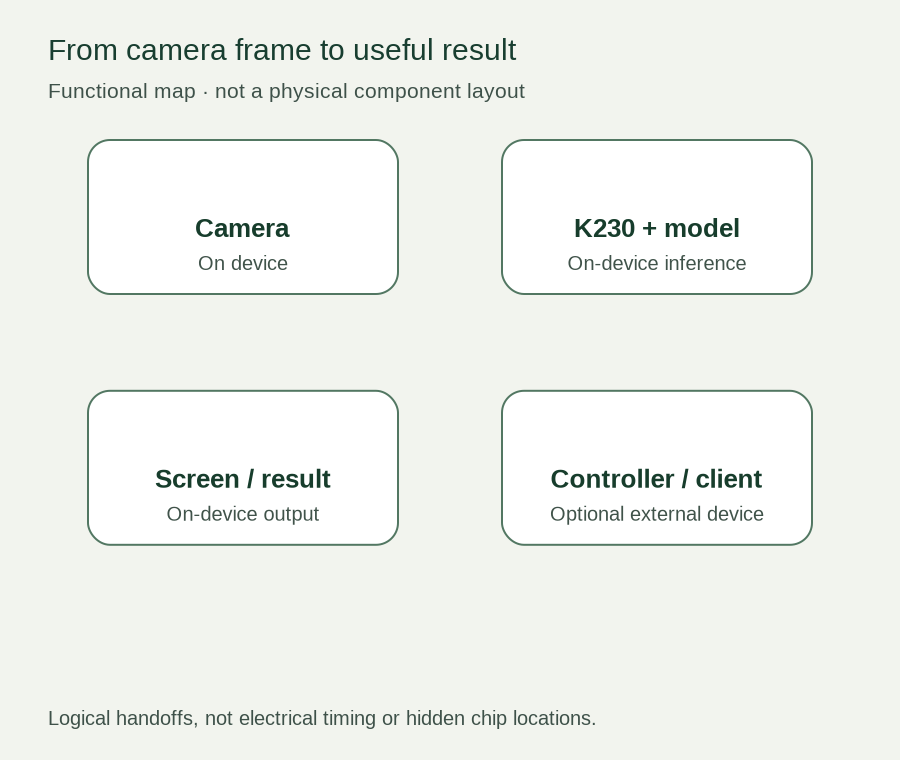
Inside AI functional illustration. Positions organize roles rather than physical components. Arrows show logical handoffs, not PCB traces or measured latency. External hosts and proposed branches are labeled; zoom enlarges this diagram only.
Inside AI; based on official documentationComponent guide
Select a number or a component to follow its role. Inspecting a component pauses the walkthrough.
Camera
GC2093 captures a frame; lighting and viewpoint determine input quality.
Is this for me?
For Arduino/ESP32 makers, educators and robotics builders who want vision results without first assembling a Linux camera stack. It is useful when an object label or position will drive a small rule. It is not evidence of production-quality defect detection, and its advertised TOPS figure does not establish application frame rate.
What you can do with it
Power the unit by USB-C, open a built-in vision function and show a fresh result on its own screen. A useful second step is learning a colored card and observing its identity as it moves through the frame. No host controller or cloud account is needed for the documented standalone screen demo.
Then use the official controller library to print recognition IDs over UART or I²C before attaching an actuator. A custom parts counter and missing-component inspection station are proposed later builds requiring a labeled dataset and validation. Official first result · Build guide · Unrun tests
What the complete setup costs
USD, DFRobot store, checked 12 Nov 2026: SEN0638-TF is $89.90 with a preinstalled 8 GB system TF card, brackets, sensor cables and power adapter board. A USB-C cable and compatible USB power source are not itemized in that shipping list; quote or reuse them. First-year standalone baseline = $89.90 + missing cable/power, with $0 required subscription. $89.90 is a conditional subtotal only when supporting power and cable are reused. Stock remains unconfirmed: the rendered page offers cart controls but that is not a verified dispatch commitment.
A controller, programming computer and actuator are optional for the screen baseline, required for their corresponding extensions. Custom model packaging requires a Windows 10+ computer; training may add GPU/rental cost. The optional Wi-Fi module is listed at $7.90, making sensor + module $97.80 before power, computer, network and API charges. MCP/cloud services are optional; no free Gemini allowance is assumed. Tax, shipping, electricity and labor excluded. Exact TF variant and contents
How to start — and what you need to learn
Follow Getting Started for power, language and touchscreen selection, then Color Recognition for learning/settings. Begin with the screen result and change one variable at a time. For controller output, match I²C/UART settings and confirm IDs before adding control logic.
Custom detection is a separate learning step: collect/annotate images, train a supported model, export ONNX, provide calibration data, generate a device package and install it. The official package generator requires Windows 10+ and .NET 7; its guide also links source for self-deployment, but another-OS workflow has not been validated here. Only specified nano architectures and 224/320/640 inputs are documented. Supported models and conversion workflow
When another product is a better choice
Choose OpenMV AE3 for a MicroPython-led sensor/control experiment if its supported model path suits you. Choose a Pi or Jetson when Linux libraries, broad model flexibility or multi-camera integration matter more than a self-contained touchscreen. HUSKYLENS is strongest when its built-in models or supported custom package format already cover your task.
What we know — and what still needs testing
The touchscreen baseline, controller library and custom package workflow are documented. Our parts-inspection project has not been built. Unresolved: real detection accuracy, converted-model latency, quantization loss, multi-model resource contention, exact stock and long-run storage reliability. The general wiki lists eMMC, but this exact shop SKU uses a preinstalled TF card; these are distinct variants.
Architecture
GC2093 camera frames enter the K230-based device, where the selected supported model performs local inference. Device software turns outputs into labels, positions and other task-specific results for the touchscreen or controller interface. The external Arduino/ESP32 handles application rules and actuators; it does not need to run the vision model.
This SEN0638-TF revision stores the system on the included 8 GB TF card, not the 8 GB eMMC described in the generic wiki. For custom models, an external computer performs training/export/packaging before deployment. For MCP, an optional Wi-Fi module exposes the device service to a separate client; the client’s LLM is not running on this camera merely because MCP is supported. Exact hardware · MCP boundary
Documented capabilities
Built-in vision functions can run from the touchscreen; recognized data can be read through the official library. The documented custom route covers YOLOv8n/YOLO11n detection plus the listed classification/segmentation variants at supported input sizes. It does not accept arbitrary model architectures. The MCP guide shows a Wi-Fi client controlling models and requesting results; some tools depend on client support. Custom model requirements
SDKs, APIs & extensibility
There are three separate levels: choose/tune built-in functions; read results from controller code; train and install a supported custom model. The public DFRobot library provides interface code, which does not establish openness of the full firmware or bundled model weights. Confirm the license in your exact library release and the obligations of your training/model stack before distribution; a device-wide open-source license has not been established here. Controller source
Limitations
No verified delivery date or stock quantity. Camera sensor frame-rate specifications are not model-throughput measurements. Custom training and calibration require representative examples; a small training set can appear successful while failing in changed lighting. The official package generator has a Windows dependency. Wi-Fi is an optional module, not included in this TF SKU. A model saying “component present” is not a calibrated industrial inspection guarantee.
Privacy & data flow
The standalone recognition path is on the device. Saving photos, streaming and enabling MCP introduce additional data paths. The documented MCP example uses an external client and Gemini API key; results/images can leave the local device depending on the tools and provider selected. Keep the first test offline and use non-sensitive objects. Assess access control before exposing the MCP endpoint beyond a trusted test network.