Espressif ESP32-S3-BOX-3 (standard kit)
Build a voice control panel that recognizes a configured command locally and confirms the action on a touchscreen. The standard kit includes the SENSOR accessory; BOX-3B does not. Free-form conversation needs a separate implementation, and current purchase pricing remains unverified.
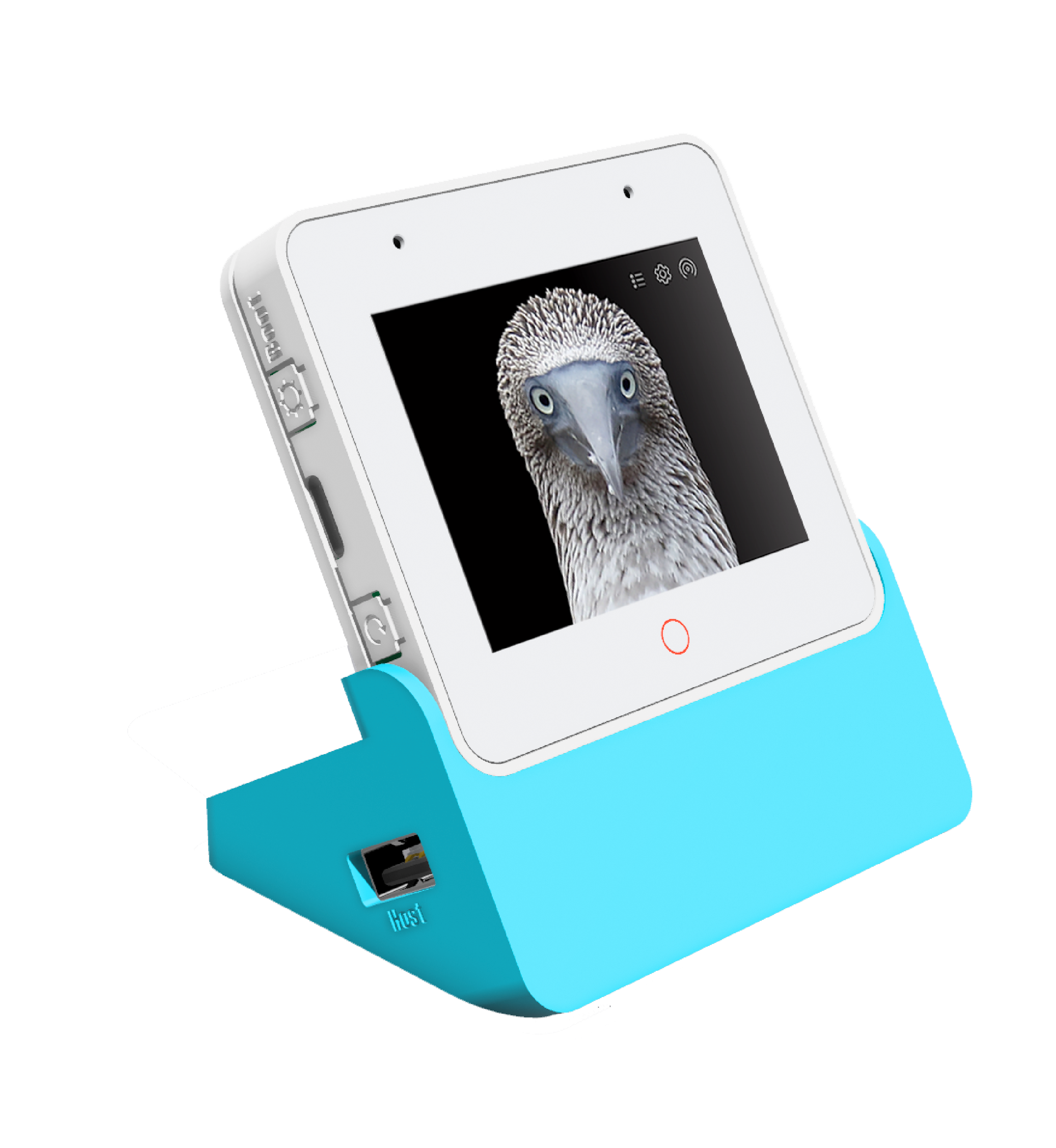 Photograph
ESP32-S3-BOX-3 — official hardware overview
Official main unit on its DOCK accessory, not our hardware test or a view of hidden chips. Espressif Systems; published in the Apache-2.0 ESP-BOX repository, used unmodified. Check standard-kit contents separately; this view is not a BOX-3B kit inventory.
Visual gallery
Is this for me?
For C/C++ embedded developers who want microphones, a screen and peripheral control in one ESP32-S3 kit. ESP-IDF is Espressif’s firmware development framework; ESP-SR supplies the speech pipeline. This is a route to an offline command panel, not a ready-made general transcription or conversational assistant.
What you can do with it
First verify the official factory demo: wake the device and say a shipped command, then see its text and the included LED respond. Use the documented language setting if testing Chinese. Next build and flash the simple image_display example before editing speech code. Our proposed workbench extension maps two configured Chinese commands to a screen timer/state with touch confirmation. First project · Official demo
What the complete setup costs
Exact standard ESP32-S3-BOX-3 kit, US purchasing basis, checked 17 Nov 2026: current device quote, stock, shipping and import/tariff treatment could not be independently verified because Mouser denied automated access. First-year formula = verified standard-kit quote + any missing host/power/data-cable cost + $0 required local-recognition subscription. Reuse a computer, suitable USB power source and a USB-C data cable; the official kit lists a USB-C power cable but does not establish it is a data cable. Microphones, speaker, screen, four blue accessories and test LED/wires are in the standard kit. A battery, microSD card and cloud API are unnecessary for this first project. Buying missing equipment adds unquoted cost, so no complete total is claimed. Taxes, freight, tariffs, electricity and labour are excluded. Retailer—quote required · Kit contents
How to start — and what you need to learn
You need a development computer, USB-C data connection, C/C++, serial logs and the ESP-IDF version specified by the selected ESP-BOX revision. Select BOX-3 in menuconfig, record the repository commit and inspect dependency manifests. The factory_demo currently declares esp-sr 1.4.*; current ESP-SR docs describe later model options that are not a drop-in guarantee for that example. Compile-time command configuration can avoid the factory mobile-app account route. No practical setup time is claimed. Developer guide · Dependency manifest
When another product is a better choice
Choose reSpeaker XVF3800 when you already have a host and need an audio front end rather than a complete display/control application. Choose Home Assistant Voice Preview Edition when Home Assistant integration is the goal. Choose BOX-3 when writing the embedded application itself is part of the project. These are architectural fit judgments; no comparative room test has been run. reSpeaker · Home Assistant Voice PE
What we know — and what still needs testing
Official sources document the standard-kit contents, offline demonstration and configurable speech commands. We have not flashed this kit, tested accents or noise, measured end-to-end latency, verified interruption during playback or integrated current ESP-SR with this older example. Current MultiNet documentation supports up to 200 commands; this is not a confirmed capacity test of the shipped firmware. Current price/stock need a retailer quote. Kit guide · Current MultiNet docs
Architecture
Runtime logical path: dual digital microphones → ESP32-S3 audio acquisition → ESP-SR audio front end (AFE: audio cleanup and formatting) → WakeNet wake detection → MultiNet configured-command recognition → application command ID/decision → screen confirmation, speaker feedback or peripheral output. MultiNet takes AFE output at 16 kHz, 16-bit mono; wake-up opens recognition. Software stages share the ESP32-S3 rather than occupying separate chips. Internal SRAM supports the runtime; the module adds 16 MB flash for firmware/models and 16 MB Octal PSRAM for working storage. USB-C provides power/programming; Wi-Fi/BLE are optional communication paths. SENSOR adds physical sensing and IR, not cloud language understanding. Optional conversation would send selected data to a separate service under application policy. This is not a PCB map or latency measurement. Hardware · Speech pipeline Explore the interactive data flow.
Documented capabilities
Official factory examples show offline wake/command handling, screen feedback and RGB LED control, plus sensor monitoring and IR ON/OFF learning with the SENSOR accessory. The IR demo learns only an ON/OFF function, so broader remote protocols and extra appliance actions still require development. Current MultiNet supports configured Chinese or English commands, up to 200 in its documented configuration; mixed Chinese/English within a command is unsupported. A phrase is matched to a command ID, not transcribed as arbitrary speech. Factory behaviours · MultiNet scope
SDKs, APIs & extensibility
ESP-BOX application examples and its published hardware/CAD material are presented under Apache-2.0; check individual files before redistribution. ESP-SR has an Espressif-specific MIT license restricting use to Espressif products, and includes prebuilt libraries/models: the recognition stack is not entirely open source. Developers can configure command text/IDs, change C/C++ application logic, build their own ESP-IDF firmware and use expansion GPIO. This does not establish a supported route to retrain every bundled speech model. The factory ESP BOX mobile-app path requires an account; the README describes commercial access for its Nova Home app architecture. Firmware-level local command configuration is a separate route. ESP-BOX source and license · ESP-SR license · Factory app setup
Limitations
Fixed-command recognition is not free-form speech transcription. Far-field performance, accents, false wakes, playback interruption and current model compatibility need hardware tests. The factory guide says commands cannot be recognized during its beep. The standard kit and BOX-3B share the main unit but have different accessories: do not copy SENSOR projects to a BOX-3B purchase without sourcing the missing module. This is an established development platform, not a new product launch. No accuracy, room range or latency claim here is an Inside AI measurement. Known demo behaviour · Version matrix
Privacy & data flow
The proposed local-only firmware can process microphone audio and configured commands on the ESP32-S3 without a recognition account or network service. That design is not a blanket privacy claim about factory firmware: mobile-app provisioning uses an account/network and factory_demo includes RainMaker dependencies. For an offline build, inspect and disable unused network/cloud code and verify behaviour with the network disconnected. If adding cloud dialogue, document which clips/text leave the device, provider retention, credentials and outage fallback; no cloud integration has been tested here. Factory account route · Example dependencies · Offline recognition