Mentra Live
Capture a first-person photo in your own mobile app, then prototype spoken assistance. Budget for the glasses and a compatible phone; custom app reliability remains untested.
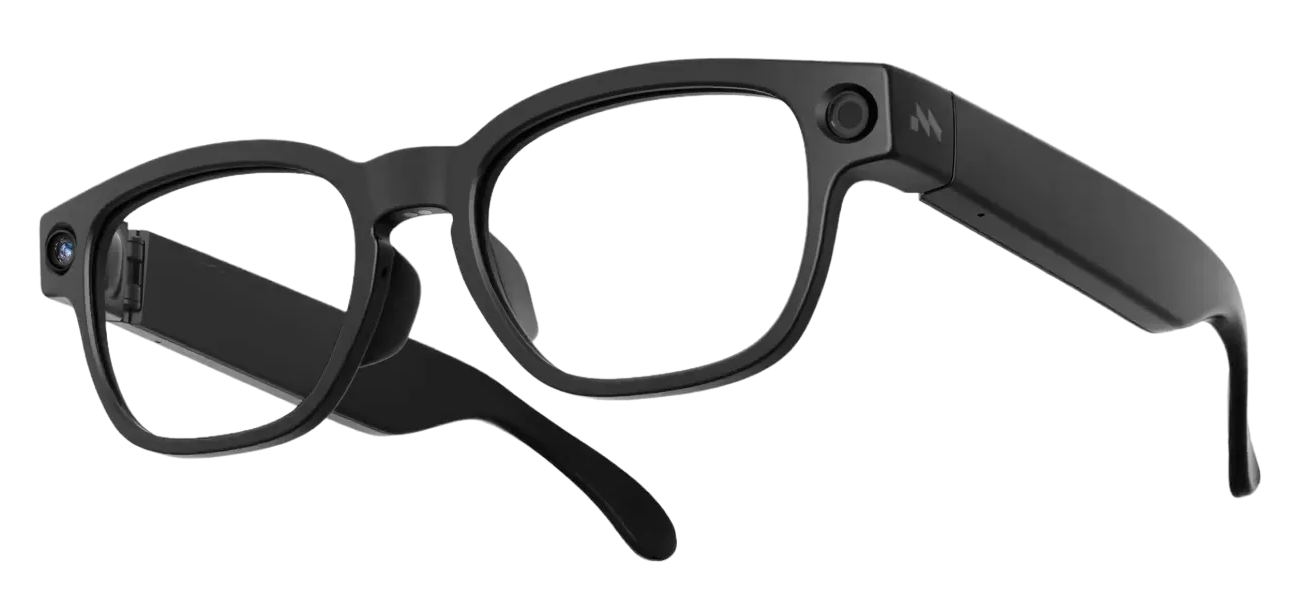 Photograph
Mentra Live — official product photograph
Official Mentra Live image. Use it to identify the exterior camera-glasses form; it does not expose hidden electronics. Copyright Mentra Labs; broad reuse permission unverified.
Visual gallery
Is this for me?
For mobile developers who need a camera, microphones, physical controls and spoken feedback while their hands are occupied. The useful distinction is documented direct device APIs, not a promise that every firmware layer is open. It has no in-lens display, so instructions must be audible or shown on a separate screen.
What you can do with it
Start with one button-triggered photo displayed in the official starter app on a physical phone. Success means a fresh image of a printed test card arrives and the app shows a completed capture, not merely a connected Bluetooth status. The starter demonstrates capture; an OCR-and-read-aloud assistant is our proposed extension.
Next possibilities: attach a voice note to a repair photo, or stream a controlled workspace to your own endpoint. These require application code and testing. Official starter · Build guide · Unrun test
What the complete setup costs
US retail, checked 12 Nov 2026: Mentra Live is $449 with charging case and Infinity Cable. A compatible physical phone, development computer, USB-C power source and connectivity are additional requirements; reuse them if suitable, otherwise obtain quotes. First-year local starter = $449 + missing phone/computer/power + any connectivity costs. $449 is only a conditional incremental subtotal with all supporting equipment already owned.
No paid cloud service is required by the documented local camera starter. The included month of Mentra Call is a separate optional calling service; its page advertises plans from $29/seat/month and also shows $89, without enough extracted tier detail to quote a complete annual contract here. Verify tier and trial eligibility before subscribing. Custom OCR, speech, streaming servers, paid API usage, mobile distribution and hosting are extra and depend on your design. Tax, shipping, electricity and labor excluded. Hardware quote · Optional Call plans
How to start — and what you need to learn
Use the Bluetooth SDK quick start and a physical phone. Choose the native Android/iOS or React Native example, install the required development tools, grant documented device permissions, pair the glasses, then use the Camera example without a separate server. Keep SDK and glasses software on a matching documented release. React Native needs a native development/production build; Expo Go is insufficient.
The shop specifies iOS 15.1+ and Android 12+, while the SDK lists its own lower-level platform minimums. Plan against both the device/app requirements and your chosen SDK rather than assuming a low Android API minimum guarantees the retail experience. Building your own app requires mobile permissions, signing/build tooling and handling disconnects; it is not just a browser script.
When another product is a better choice
Choose Ray-Ban Meta if your priority is a supported consumer capture/assistant experience and its available integrations fit your needs. Consider Frame for a display-led experiment, subject to its own API and hardware limits. A phone on a mount is cheaper to prototype with when wearing the camera adds little value. Mentra is interesting when direct capture and custom app behavior justify the extra hardware and maintenance.
What we know — and what still needs testing
Documented: capture, audio, lifecycle events and local/remote media examples. Proposed: our repair logger, OCR reader and LAN assistant. Not tested here: image-transfer latency, long-session capture, background survival, audio routing, battery endurance or recovery after phone sleep. Firmware openness and first-time account requirements are not established by the material reviewed. Official example repository records manufacturer examples, not our measurements.
Architecture
The glasses capture images and audio and expose controls through a device SDK. The phone app manages connection state, receives media and decides what to do next. Bluetooth is part of the control/connection path; media delivery can use supported Wi-Fi or fallback routes, so do not equate the Bluetooth SDK name with every video byte travelling over BLE.
In our proposed OCR design, image decoding/OCR runs on the phone or an explicitly chosen external service, then speech returns to the glasses. That inference stage is application work, not an AI model claimed to run on the glasses. The official quick start provides local camera/stream examples and optional server helpers. SDK scope
Documented capabilities
Documented interfaces cover camera capture, microphone/audio, button and touch events, device status, Wi-Fi and streaming. The examples demonstrate RTMP, SRT and WebRTC paths; their local helper includes WHIP. Available behavior is model- and software-version-dependent. The glasses provide audio feedback without a visual display. Examples and setup
SDKs, APIs & extensibility
Use Kotlin, Swift or React Native through the documented SDK packages. Develop your own app and endpoint, and keep coordinated SDK/firmware versions together. The MentraOS repository carries an Apache-2.0 license; confirm notices and dependencies in the exact SDK release you ship. This does not establish unrestricted access to every glasses firmware layer. Hosted Mentra services have separate terms and costs. MentraOS license
Limitations
The official shipping policy limits website retail orders to US addresses. Its 2–5 business days is processing, followed by an estimated 2–7 business days delivery; neither is a guarantee. Battery claims depend on use and are not our measurements. Mobile operating systems can suspend background work, and camera access or a connected status does not prove a continuous capture pipeline. No confirmed general-purpose display or unrestricted custom firmware access. Shipping scope
Privacy & data flow
Your app determines whether captured frames/audio remain on the phone, go to a local endpoint or reach a cloud provider. A local sample does not prove that all retail services are local. Use staged scenes with consent, inspect destination URLs and logs, and test WAN loss before claiming offline operation. Confirm account/onboarding dependencies on a real unit. Do not retain incidental first-person recordings by default in the proposed logger.