M5Stack UnitV2 AI Camera (U078-D)
Get local object labels and boxes from a small camera over USB or UART, then use those results in a controller project. The $60 kit includes the camera, cable, card and stand; custom-model training is a separate online step.
Illustrative sequence and routes; timing is not measured.
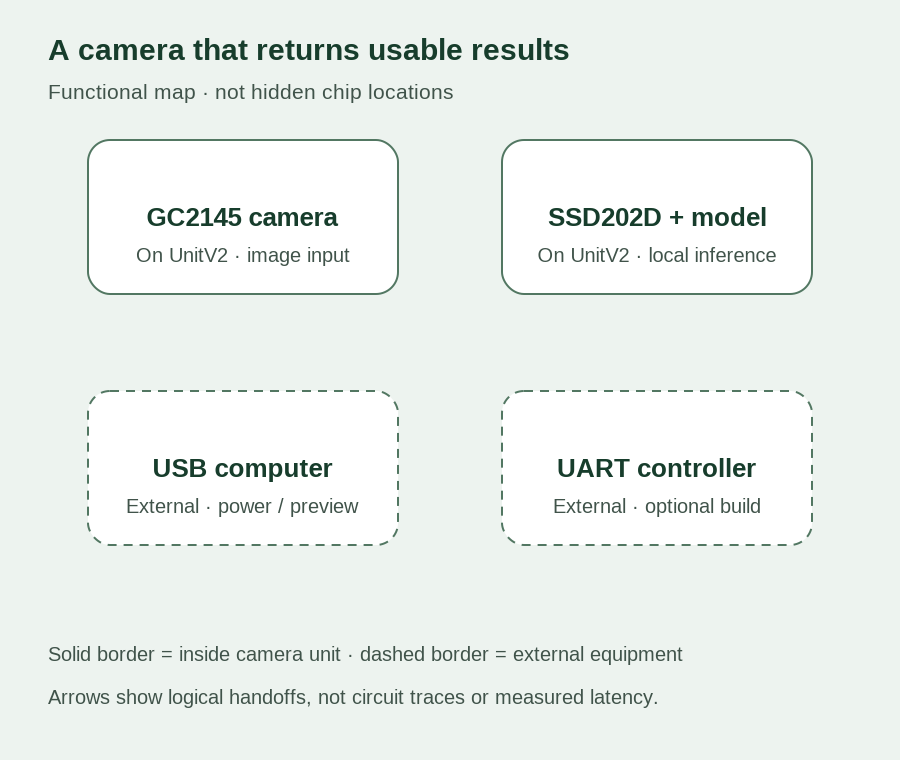
Functional map, not physical chip locations. Dashed boxes are external equipment. Arrows show logical handoffs, not PCB routing, electrical timing or measured latency. Zoom enlarges the drawing only.
Inside AI; based on M5Stack documentationComponent guide
Select a number or a component to follow its role. Inspecting a component pauses the walkthrough.
GC2145 camera
Built into the U078-D camera assembly. It supplies color frames; the sensor rating of 1080p is not the same as the 480p documented browser preview.
Is this for me?
For a maker who wants a compact camera to return useful recognition results without first training a model: a bench counter, a person-presence indicator or a simple robot trigger. The UnitV2 runs its documented built-in vision functions on its own Linux board and sends results to a browser or UART host. It is a poor fit when you need raw-image ownership, modern model flexibility or a robust outdoor camera.
What you can do with it
First observable result: connect the included USB-C cable to an existing computer, open the local UnitV2 page in Chrome, select Object Recognition and place a familiar object such as a bottle in view. Expect a live preview plus a label and box that change when the object moves; the documented UART output contains JSON with type, confidence and coordinates. M5Stack supplies the built-in NanoDet/YOLO-Fastest functions. Official first-run guide · Starter project
Proposed next build: read the JSON on an external controller and turn a low-voltage indicator on only after repeated matching detections. The debounce and physical output are our untested application logic, not a factory function. Stability experiment
What the complete setup costs
USD, M5Stack official international store, checked 22 Nov 2026: exact SKU U078-D is $60 sale price (crossed-out $75) and the sole variant showed available, with the page saying 10+ in stock. Availability and checkout price can change. The box includes UnitV2, 32 GB microSD card, 50 cm USB-C cable, stand and back clip. It requires a computer with a compatible USB connection for this first browser result; power is specified as 5 V/500 mA. Store · Exact-SKU feed · Included parts
First-year formula for the local first result: $60 camera kit + $0 required subscription + the cost of a missing computer/USB power capability. Conditional incremental subtotal is $60 if a suitable computer is already owned; the full all-new total is unknown because a new host is unquoted. No separate camera, card, cable or stand purchase is needed for this milestone. Optional external UART controller, connector, LED and enclosure need their own quote. M5Stack V-Training for a custom model is optional, requires an account and uploaded training images; current quotas and charges are unverified, so no custom-model total is claimed. No paid API, hosting, annual plan or trial is assumed for built-in local recognition. Tax, shipping, electricity, internet access for downloads and labor excluded.
How to start — and what you need to learn
Beginner-friendly first result if you can install a USB network driver when required and use Chrome. Connect U078-D with its included cable, wait for boot, then visit unitv2.py or 10.254.239.1 and choose Object Recognition. On macOS or Windows, follow M5Stack’s SR9900 driver instructions if the device network does not appear. The factory access point is another documented route, but a default Wi-Fi password needs changing before broader use. Keep the first run on a controlled bench with harmless objects. Connection guide
Reading UART JSON or running Python in the bundled Jupyter notebook is the next skill level. Training your own model uses V-Training registration, data collection/labeling and an upload, then model loading on the device; it is not needed to confirm the first result. Notebook · Training
When another product is a better choice
Choose HUSKYLENS 2 if a built-in screen and a documented custom YOLO deployment path matter more than the lower starter price. Choose Grove Vision AI V2 for a small separate camera/module workflow and Himax MCU/NPU experiments. Choose OAK-D Lite when stereo depth and a richer host pipeline are needed. UnitV2 is a middle ground for ready local vision functions and simple JSON output; those fit judgments are not performance test results.
What we know — and what still needs testing
Documented: exact U078-D contents and price, GC2145 camera, SSD202D Linux board, built-in recognition web page, UART JSON and a Python notebook. M5Stack describes built-in models and V-Training; we have not checked the shipping firmware, model accuracy, service availability or device behavior. Proposed: a debounced bottle/person indicator. Test label stability under changing light, confidence and false triggers; verify end-to-end output delay, Wi-Fi behavior, UART parsing, firmware/license boundaries and what network traffic occurs before deploying it. The official video demonstrates use, not a measured result by Inside AI.
Architecture
A GC2145 sensor captures color frames. The UnitV2 SSD202D system runs Linux and the selected built-in recognition function, performs detection and post-processing, then exposes live preview over its USB-created network or Wi-Fi access point and sends recognition JSON over the bottom UART (115200 bps, 8N1). An external computer displays the web UI and supplies USB power; it is not required to run the documented built-in model. An optional external microcontroller can parse JSON and act on it. The 128 MB DDR3, 512 MB NAND and included 32 GB microSD support the device’s software/storage; the public documentation does not justify assigning individual model stages to hidden chips. Hardware · Function outputs
Documented capabilities
M5Stack documents camera stream, object recognition, face detection, color tracking, QR/code detection and other built-in functions. Its object recognition page shows YOLO-Fastest and NanoDet options and JSON results with class, confidence and box. The GC2145 is a 1080p sensor, while the documented camera-stream preview is 480p; sensor resolution does not imply 1080p AI output. A microphone and 2.4 GHz Wi-Fi are present. Actual detection accuracy, frame rate and multi-function concurrency are untested here. Function reference
SDKs, APIs & extensibility
Read/control boundary: the browser service exposes function switching and preview, and UART emits JSON; M5Stack provides an Arduino integration guide. Application boundary: a factory Python 3.8/Jupyter notebook can run examples for LED and camera, while M5Stack’s UnitV2Framework repository is Apache-2.0 licensed. Model boundary: custom classification/detection via V-Training requires a registered online account, labeled uploads and model download; pricing/quota terms and export freedom have not been verified. Repository licensing does not establish that the full firmware, bundled models or silicon SDK are open. Flashing/replacing the factory image is a separate documented firmware workflow and should not be conflated with editing a notebook. Notebook · Framework · Training
Limitations
The browser guide recommends Chrome and warns about Safari compatibility. Windows/macOS may need the SR9900 USB network driver; M5Stack recommends its own cable to avoid connection crashes, and the included cable is the known first option. Browser output and UART JSON do not prove an unrestricted image API or arbitrary custom-model support. The unit is not a depth camera and the first recognition functions are fixed until model work is done. V-Training may change or require an account; its present quotas are unverified. Connection/compatibility
Privacy & data flow
For the documented built-in first result, capture and recognition run on the UnitV2 and the preview/JSON are exposed on the local device network and UART. The factory access point and any connected host are part of the trust boundary: do not point it at private spaces or leave the documented default AP credentials in a shared environment. V-Training is a separate optional online path that uploads labeled images to M5Stack’s service. We have not packet-captured the device or verified retention and telemetry. Use non-sensitive test objects and check traffic before claiming an offline-only deployment. Local connection · Training upload