M5Stack Unit ASR (U194)
Add offline spoken commands to an Arduino project. Start by changing a screen with your voice; custom vocabulary takes a separate online firmware-generation step.
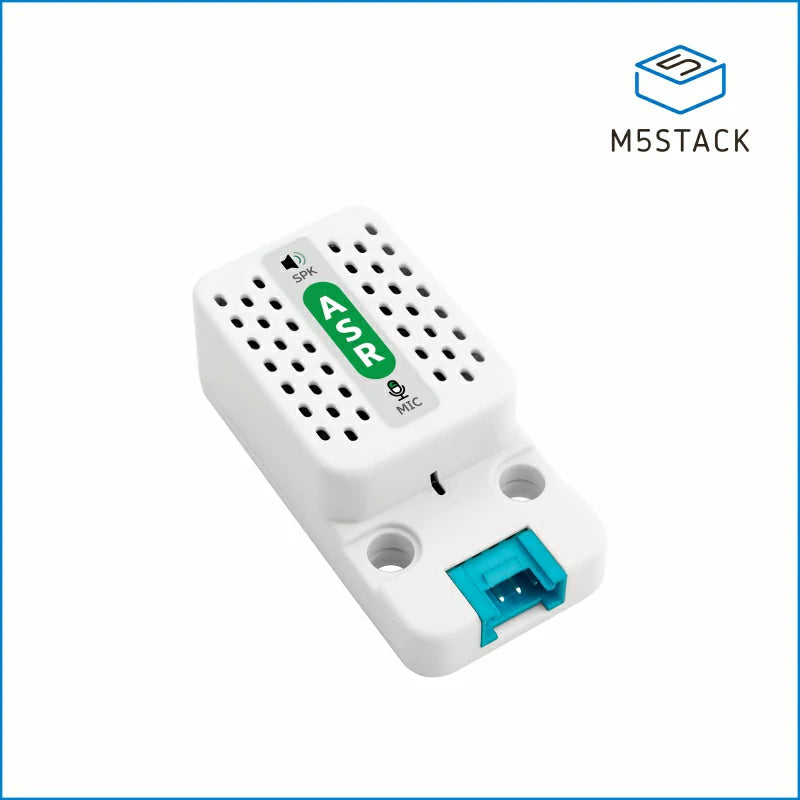 Photograph
Unit ASR enclosure and UART connector
Official U194 product photo. The enclosure view identifies the unit and connector; it does not reveal hidden component locations. Copyright M5Stack; separate reuse permission is unconfirmed.
Visual gallery
Is this for me?
For Arduino makers adding a few spoken controls to an existing device: a desk indicator, a robot mode selector or a hands-busy interface. The useful output is a command ID, not an open-ended transcript or a conversational answer. Start with a harmless screen change before connecting an actuator.
What you can do with it
First observable result: use M5Stack’s CoreS3 Arduino example, say “Hi M Five”, then “Turn on” and “Turn off”. The host screen and serial log should show the matching command; the module supplies spoken feedback. The official example simulates light control—it does not switch a physical lamp. Official example · Starter guide
Proposed next build: a voice-controlled desk status display. Map only two recognized IDs to AVAILABLE/BUSY, keep a manual button, and log wrong or repeated triggers. Test the command boundary
What the complete setup costs
USD, official international M5Stack store, checked 15 Nov 2026: Unit ASR U194 $7.50 including the 20 cm Grove cable; CoreS3 K128 $59.90 for the exact official Arduino starter. Both pages displayed 10+ in stock; delivery and taxes depend on destination. U194 quote · K128 quote
First-year starter = $7.50 + $59.90 if buying the CoreS3 + $5–15 editorial allowance for a USB-C data cable/suitable power + $0 required inference subscription, using an existing programming computer: $72.40–82.40. With CoreS3, cable, power and computer already owned, incremental cost is $7.50. A missing computer is an unquoted required item, not zero. The Grove cable, microphone and feedback speaker are included; no extra microphone, speaker, camera or storage is needed for this example.
Custom vocabulary is optional: add a compatible UART downloader, any platform charges and your development work; current downloader price and Smart Pi service terms/quotas are unverified, so that expanded setup has no verified complete total. No monthly/annual plan or trial is assumed. Optional connected-host APIs/hosting add usage charges. Tax, shipping, electricity and labor excluded.
How to start — and what you need to learn
Basic Arduino/C++ and USB flashing skills. Install the board support plus M5Unified, M5GFX and M5Unit-ASR; connect U194 to the documented CoreS3 UART port using the included cable; upload the official Turn On/Off sketch. Follow its board-specific RX/TX pin mapping rather than copying pins to a different ESP32. Open the serial monitor at 115200, wake the unit and compare the display, command ID and spoken acknowledgement. Setup and code
Registering a callback only handles an existing command ID; it does not teach a new phrase. Custom words require Smart Pi account registration, configuration, firmware generation and a separate UART flashing workflow. The guide says one language at a time, not mixed Chinese/English. Desktop compatibility, recovery after a failed flash and current platform availability still need a real-device check. Vocabulary workflow
When another product is a better choice
Choose Nicla Voice when collecting your own audio dataset and building an embedded sound classifier is the main learning goal. Choose Home Assistant Voice Preview Edition for a ready home-assistant interaction path, or reSpeaker XVF3800 for host-side transcription and microphone-array experiments. Unit ASR is an inexpensive command peripheral; it is a poor match for dictation, open-ended questions or arbitrary neural-model deployment. These are editorial comparisons, not measured performance rankings.
What we know — and what still needs testing
Documented: U194 hardware/interface, 42 factory English commands, up to 300 configured words, the CoreS3 callback example and the account-based firmware generator. Manufacturer claims about AEC and recognition are not our accuracy results. We have not tested hardware. Test wrong triggers during TV speech, wake/command misses across speakers, duplicate UART events, recovery after power loss and a custom single-language firmware before relying on it. The optional generator’s long-term pricing, underlying speech-model license and end-to-end tool compatibility remain unverified.
Architecture
Speech reaches the analog microphone inside U194. Its CI-03T module handles the documented offline speech-processing/recognition path; AEC and noise reduction are manufacturer-described functions, not separately identified chips in our diagram. A recognized configured command produces local spoken feedback and a UART message. The external CoreS3 parses that message, selects a callback and updates its display. Neither the display nor its application logic is inside U194. Hardware reference · Host example
The documented custom-command packet is AA 55 ID 55 AA. Preserving this format and unique IDs keeps generated commands compatible with the library. This compact event interface is different from streaming microphone audio to a host; the reviewed API does not establish a general PCM-streaming interface. Packet compatibility
Documented capabilities
The factory firmware includes 42 English wake/response commands. Documentation specifies UART at 115200 baud, 8N1; voice-keyword or UART wake; microphone and an 8Ω / 0.8W feedback speaker. It lists up to 300 configured command words and Chinese, English, Japanese or Korean configurations. The custom guide restricts a firmware configuration to one language at a time. Do not read “300 words” as unrestricted dictation. Unit reference · Language limitation
M5Stack also describes voiceprint recognition and mid-session interruption. The reviewed Arduino example does not demonstrate enrollment, speaker authentication or secure authorization. Treat those as vendor capability claims requiring separate API and behavior verification.
SDKs, APIs & extensibility
Application layer: M5Unit-ASR registers command IDs and callbacks, reads the current command and raw message, and uses the host UART. Its repository identifies the library as MIT licensed. Library and license
Vocabulary layer: import M5Stack’s configuration template into Smart Pi, edit words/responses, preserve the UART packet convention, generate a binary and flash through the module’s UART interface. This requires an account and downloader; it is not a runtime call that trains a word. Firmware generation and flashing
Model/firmware layer: an available binary, library or schematic does not establish an open speech model or fully redistributable firmware toolchain. Arbitrary model upload, underlying model licensing, complete firmware source and commercial generator terms are unverified. Official enclosure STL files exist; their availability alone does not establish reuse permission. Structure files
Limitations
Start with the supplied English commands; mixed-language recognition is explicitly unsupported by the current customization guide. Nearby speech or a TV could produce valid-looking IDs, so an application must decide how to reject repeats and recover after missed commands. Do not use this unauthenticated voice trigger as an access-control credential. Firmware restrictions
The reference lists 5V / 47.73mA standby and 5V / 250.12mA working (manufacturer figures, conditions not detailed), 0–40°C operation and a 48 × 24 × 16 mm enclosure. These figures do not establish battery runtime, usable distance, accuracy or latency. 5V supply is not proof that every UART pin tolerates 5V signals; follow the documented board connection. Product weight differs slightly between reference and shop (10.6 vs 10.7g); no weight claim is used for a design decision. Electrical and environmental reference
Privacy & data flow
The factory command path is documented as offline: microphone → module recognition → local feedback / UART ID. The CoreS3 example handles events locally; an internet connection is not part of that runtime example. This is documentation-based, not a network or firmware audit. A connected host could later transmit IDs or logs, depending on the application. Reference · Example
Customization is a different boundary: account registration and command/response configuration go to the Smart Pi online platform, which generates firmware. Avoid sensitive names or private command text until its retention and account terms are reviewed. We have not verified the service’s telemetry, retention or underlying model provenance. Account and configuration flow