Jetson Orin Nano Super Developer Kit
Build a small local text or vision assistant with a Linux GPU computer. Plan the storage, memory and software work beyond the kit price.
Illustrative sequence and routes; timing is not measured.
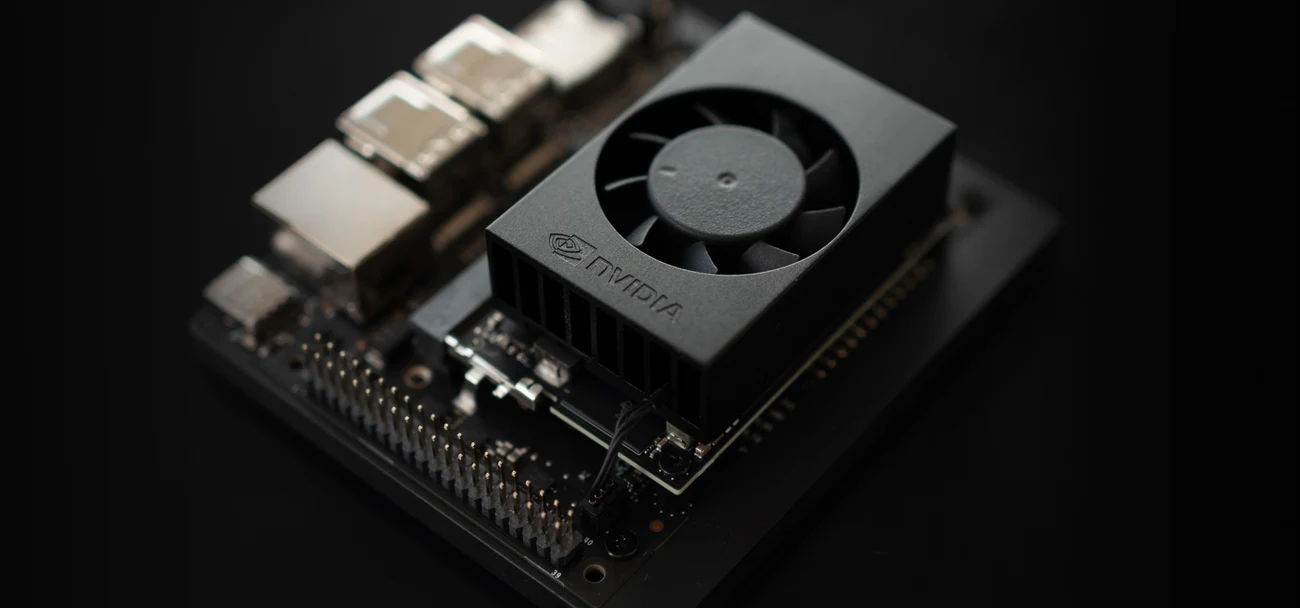
The compute marker points to the module beneath the cooler. CPU, GPU and shared memory are hidden, so their internal steps highlight that same module rather than invent chip positions. The strip below locates software and storage conceptually; it is not extra hardware in the photograph. Signal timing and routes are illustrative.
NVIDIA · Jetson Orin Nano developer kitComponent guide
Select a number or a component to follow its role. Inspecting a component pauses the walkthrough.
Local app on Jetson
A terminal or form sends a prompt to a local inference service. For our proposed work-order extractor, the input is a typed repair note. The developer kit has no built-in microphone or camera; adding either requires another capture stage. The validation and review stage also runs in this app; this external label is a software role, not a separate device.
Is this for me?
For developers who want a small Linux GPU computer for local language or vision models and can manage software versions, storage and power. Its appeal is a flexible development stack. The shared 8GB memory still limits model size, context and concurrent tasks.
What you can do with it
Proposed first result: turn a short work-order note into a small JSON record locally, then flag unsupported part numbers or dates for review. A camera-based bench assistant is a later extension. Begin with a compact model and one task; do not buy assuming a large cloud assistant can be reproduced unchanged. Local work-order build
What the complete setup costs
NVIDIA’s official reference, re-read 10 Nov 2026, is $249 for the developer kit. The library budgets another $30–70 for storage/setup extras: $279–319 for the text-only prototype, assuming an existing setup computer and the kit power supply. An optional $20–60 camera allowance makes a camera build $299–379. These are estimates, not stock or checkout confirmation.
Local inference has no compulsory service subscription. Add electricity, tax/shipping, any display/input devices you need and optional cloud training or APIs. Edit owned items and quotes
How to start — and what you need to learn
Follow the Jetson getting-started image and storage instructions, verify the installed JetPack version, and run one supported small model before building an interface. Download needed model files first; then test the task with network access removed. Learn Linux, runtime/model compatibility and memory monitoring. Setup
When another product is a better choice
For a fixed detector on a Pi you already own, AI HAT+ may be a more focused addition. For a very small sensor classifier, a microcontroller avoids a Linux computer. Compare full task latency and memory needs, not TOPS numbers across different precisions and architectures.
What we know — and what still needs testing
GPU/memory configuration and reference pricing are documented. We have not benchmarked this kit. Measure peak memory, time to first result, sustained heat and incorrect structured outputs; successful model loading alone is insufficient. Work-order test
Architecture
This kit combines a six-core Arm CPU and an Ampere GPU on one module. Both draw on the same 8 GB LPDDR5 memory. For a local text assistant, Jetson Linux, the model weights and the model’s working state all need room at the same time. Increasing the context length can therefore change whether a particular model fits. NVIDIA · Orin Nano Super hardware and modes · Ollama · Local operation and network configuration
Consider a technician who types a short repair note. A program on the Jetson sends it to a local Ollama service. The runtime loads the model, evaluates the prompt, then generates output tokens one at a time. The application parses the answer into fields and asks the technician to confirm them. Load time, prompt evaluation and generation are separately visible in the API response. Ollama · Generate API · Ollama · Response metrics
Documented capabilities
NVIDIA demonstrates local language-model inference on this kit. Start small with the text-only Llama 3.2 3B model. Ollama lists its Q4_K_M download at about 2 GB. Runtime memory also includes model state and context, so disk size alone cannot establish available headroom. NVIDIA · Orin Nano Super hardware and modes · Ollama · Llama 3.2 3B model card
Our proposed application handles one small job: turn a typed bench note into a part ID and a final quantity. Include a correction such as “two filters, correction: three.” With known answers, you can check useful work per request instead of judging a fluent paragraph by eye. Build the work-order extractor
SDKs, APIs & extensibility
Start at the service boundary. One application can call the local HTTP API from a terminal, another from a form, while both use the same loaded model. Give the response a machine-readable shape, check types and values, then present a draft for confirmation. Keep a missing quantity empty so the workflow has a way to express uncertainty. Ollama · Generate API
If a correction goes missing, preserve the input and try the same prompt with one changed factor. Alter the model tag, prompt or context budget in separate runs. For reproducibility, record the local model ID as well as the tag shown by the registry. Ollama · Llama 3.2 3B model card
Limitations
NVIDIA’s 67 TOPS figure counts peak sparse INT8 operations. A language generator spends time loading weights, reading memory and extending its token history. Measuring time to finish a repair note answers a different question from counting peak arithmetic operations. Log wall time, generated tokens per second, memory and failures on the actual kit. NVIDIA · Orin Nano Super hardware and modes · Ollama · Response metrics
A response can be valid JSON and still contain the wrong quantity. Score a corrected count, an absent count and a repeated part name independently. An allocation failure or timeout belongs in the total attempted requests. Run the quality and memory test
Privacy & data flow
A local model and a client calling the loopback address can process bench notes on the device. Setup still requires obtaining the runtime and model files. Ollama’s network configuration can expose its API beyond the local machine, and a developer can separately choose a remote model or an upstream service. Review the actual server address and model selected. Ollama · Local operation and network configuration
For a proposed offline check, provision the files first, disconnect networking and submit an invented note. Inspect the terminal history, application logs and output file afterward. A successful offline request demonstrates that run’s independence from a live connection. It does not establish a retention policy for every application on the Jetson.