Arduino Nicla Voice
Give a small device an offline wake-word trigger. Start with the built-in LED demo, then test whether a custom phrase works reliably in your room.
Illustrative sequence and routes; timing is not measured.
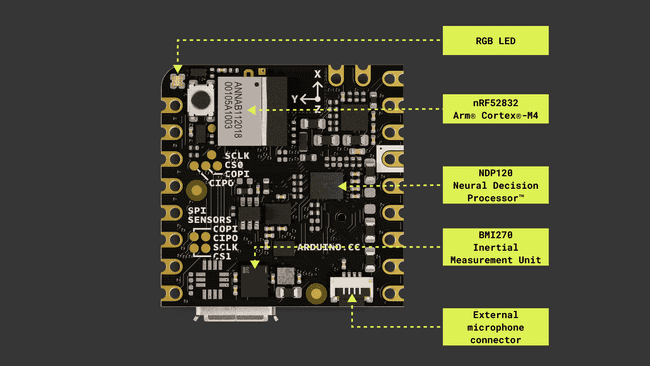
Official top-view map. The onboard microphone is on the other face and is represented below rather than assigned a false top-side position. NDP120 recognition and the application MCU have different jobs. Arrows show logical handoffs, not electrical traces or measured timing.
Arduino documentation · CC BY-SA 4.0Component guide
Select a number or a component to follow its role. Inspecting a component pauses the walkthrough.
NDP120 neural processor
Runs a compatible deployed recognition model. Keyword/event detection is not full conversational transcription.
Is this for me?
For Arduino makers building a hands-free prop, desk interface or narrow sound-triggered device. It suits a small set of learned audio events and local responses. It is not a ready-made conversational assistant or a general speech-to-text recorder.
What you can do with it
First observable result: power a factory-configured board and say the demo wake word, “Alexa”; Arduino documents a blue LED response. That is a local keyword demo, not an Amazon Alexa service connection. Our proposed extension logs one timestamped trigger per utterance over USB, with a short cooldown to suppress duplicates. Starter build
After that baseline works, train a deliberate phrase for a tabletop prop or hands-free counter. Custom vocabulary and downstream automation are proposed builds; they are not included trained features. Official demo
What the complete setup costs
US / USD, checked 11 Nov 2026: Nicla Voice ABX00061 is $32.11, with available=true in the official product feed; its $49.40 compare-at value is not the current selling price. Checkout delivery, tax and shipping are unverified. The micro-USB cable is not included. Reuse a development computer with a suitable USB port and USB power; add a data cable and simple board support if needed.
First-year USB starter formula: $32.11 board + $5–15 editorial cable/support allowance + $0 required cloud subscription = $37.11–47.11. With a suitable cable and support already owned, incremental hardware is $32.11. This assumes the computer is already owned; otherwise add an unquoted computer cost. No trial is assumed. Tax, shipping, electricity and labor are excluded.
Optional battery with the correct connector, enclosure, external microphone, BLE receiver and controlled equipment need separate quotes. Custom training can start with Edge Impulse Developer at $0/month, subject to its limits and Syntiant terms; Enterprise is custom-priced. Paid-plan eligibility and commercial deployment rights are not confirmed here. Cloud APIs, a network gateway and hosting are optional, unquoted additions, not included in the local subtotal.
How to start — and what you need to learn
Begin with USB power and the factory demo before installing a custom model. For serial output and sketch changes, install Arduino IDE and Arduino Mbed OS Nicla Boards, select Nicla Voice, and use the NDP AlexaDemo example. If the board was reflashed, follow the manual’s firmware restoration steps, preserving any existing model first. Expect Arduino/C++ basics and serial-port troubleshooting.
Custom training adds labeled recordings, held-out evaluation, a cloud account, CLI tools and compatible NDP packages. First prove that the current toolchain can export and flash a tiny target model before collecting a large dataset. We have not measured setup time or executed the uploader.
When another product is a better choice
Choose Home Assistant Voice Preview Edition for a packaged home-assistant voice interface and speaker, with its separate host requirements. Choose Nano 33 BLE Sense Rev2 for general sensor/TinyML learning. If a button or simple sound-level threshold solves the problem, start there before taking on a trained keyword detector.
What we know — and what still needs testing
Verified from official sources: factory keyword-to-LED example, two-processor design, NDP firmware workflow and target-specific model deployment documentation. Unverified: current custom-model export on your account/OS, false-trigger rate, recognition across speakers and enclosure positions, whole-project power and battery life. Unrun room test
The Edge Impulse target guide requires a single negative class, sorted last, and acceptance of a Syntiant EULA. Arduino’s general tutorial initially collects unknown and noise separately: merge them as the target guide specifies before deployment. No hands-on results are claimed.
Architecture
The IM69D130 microphone sends digital audio over PDM to the Syntiant NDP120. The NDP120 contains a neural inference engine, audio DSP and control processor. A deployed model and its decision settings turn audio windows into candidate events. The nRF52832 inside the ANNA-B112 module runs the Arduino application and BLE; it communicates with the NDP120 over SPI and decides what a detected event should do. Board reference, sections 4.3–4.7
The nRF52832 also accesses 16 MB external flash; stored firmware/model files are not extra working RAM. BMI270 motion and BMM150 magnetic sensors connect to the NDP120. A SAMD11 supplies the USB programming/debug bridge, and power-management circuitry supports USB or a suitable battery. For the starter, follow microphone → NDP model → Arduino event handler → LED/USB. Detailed walkthrough
Documented capabilities
Included/documented baseline: a wake-word demo with LED feedback. Supported developer workflows include audio capture, custom audio classification and motion-model exploration; the NDP library exposes event handling and audio extraction. These are building blocks, not a finished appliance detector, speaker-authentication system or assistant. Manual
A useful extension is a deliberate spoken trigger for an exhibit or counter. An appliance sound logger is another possibility, but requires recordings from the actual appliance and negative examples from the room. A successful demo utterance does not establish dependable continuous operation.
SDKs, APIs & extensibility
Arduino Mbed OS Nicla Boards includes the NDP examples. NDP.onEvent registers an application callback, while NDP.begin and NDP.load load the required packages; ArduinoBLE supports a wireless extension. The documented Record_and_stream example extracts audio, with an explicit arduino-audio-tools v0.9.6 dependency. Treat these version constraints as setup work. Manual
For custom models, the official Edge Impulse target workflow uses Arduino CLI and Edge Impulse CLI, separate MCU/model flashing scripts and an NDP-compatible export. It links the open-source board firmware at github.com/edgeimpulse/firmware-arduino-nicla-voice. Open firmware does not remove the separate Syntiant model EULA. Do not assume arbitrary ONNX/TFLite models can simply be copied onto the board. Account entitlements, OS/uploader compatibility and commercial terms need verification before committing to a product.
Limitations
This is a small event classifier, not a Linux computer or an on-device large language model. The nRF52832 has 64 KB SRAM and 512 KB flash; application and NDP resources serve different roles. Microphone placement, background speech, similar words and repeated playback can change outcomes. A keyword match does not authenticate a person or prove that a live person spoke.
The manufacturer reports typical battery-side current at 3.7 V of 0.80 mA for the factory Alexa demo with BLE off, versus 2.4 mA with BLE advertising and 1 Hz sensor polling. These conditional reference figures are not our measurements or a battery-life guarantee, and do not describe every USB/custom-model configuration. Power table
Battery operation requires the correct connector and charging setup; the manual says charging is disabled by default. Keep the first build on USB. Do not infer that broad NDP marketing capabilities such as beamforming or noise suppression are enabled in the supplied single-microphone example.
Privacy & data flow
The starter performs inference on the board and needs no cloud connection at runtime. An optional USB event log contains timestamps and trigger labels rather than raw audio; that is our proposed application choice, not a universal hardware guarantee. The supported recording example can stream audio to a computer. Manual
The documented custom-training workflow uploads labeled recordings to Arduino/Edge Impulse services. Use consented demonstration speech, inspect project visibility and retention, and distinguish training uploads from later local inference. A BLE receiver or cloud integration adds its own data path. Our proposed test checks offline behavior and saved artifacts; it has not been run.