Synaptics Coralboard SL (2 GB)
Turn a spoken request into a visible LED action while learning which work belongs on the CPU and Coral NPU. The official voice example needs a separate Sensor HAT and careful provisioning; this is an untested development guide.
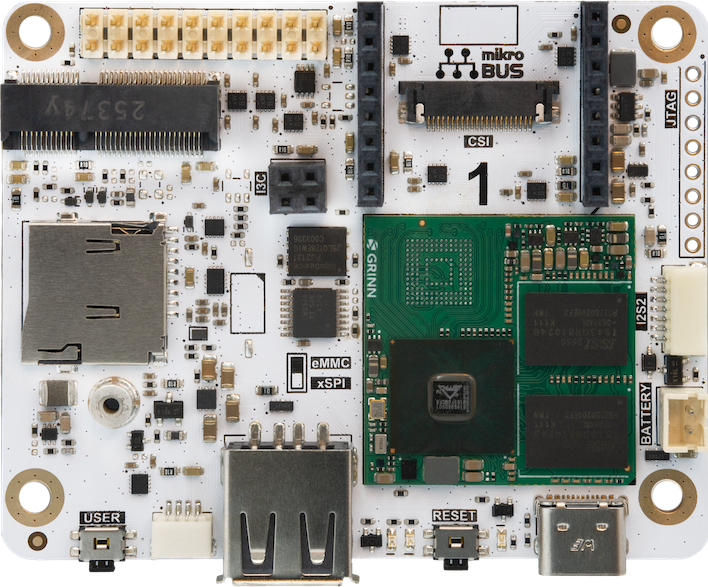 Photograph
Coralboard SL — official front view
Official SL board photograph from the developer guide, checked 13 Nov 2026. Sensor HAT and other accessories are separate. Copyright Synaptics; reuse authorization is not established. Remote source may change.
Visual gallery
Is this for me?
For Python and Linux developers who want to inspect an open compiler/runtime and build a small local sensing-to-action application. You should be comfortable flashing a card, using a shell and managing model dependencies. This is a development board, not a finished voice assistant, and 2 GB of RAM makes model selection part of the work.
What you can do with it
Start with the official Function_calling example: type “Turn the red light on” and confirm that a Sensor HAT indicator changes as well as a tool call appearing in the log. Then enable real Moonshine voice input and repeat the request by speaking. The HAT is an extra purchase; a microphone is required for the voice stage. The documented HAT PDM microphone can supply it. Stub voice mode returns canned text and is not evidence of speech recognition.
A blue-light sequence and a tool checkout recorder are proposed extensions. The stock YOLOv8n model covers 80 classes, so it does not identify every workshop tool or track borrowing without added logic and possibly custom training. Official example · First build · Unrun experiment
What the complete setup costs
US distributor / USD, incoming research dated 13 Nov 2026: Coralboard SL 720-KDVSL2619-11 was quoted at $99.79 and the Sensor HAT at $31.25. The import recheck could not pass DigiKey’s access challenge, so these are supplied research quotes, not newly confirmed live prices. The reported quantities (3,253 boards; 319 HATs) are historical snapshots, not stock or delivery guarantees. Board listing · Sensor HAT
First-year voice build = $131.04 quoted board/HAT subtotal + compatible microSD (at least 16 GB, A1/C10 or better) + card reader if needed + USB-C data cable + adequate 5 V power + development computer if not owned + any missing microphone. The included HAT microphone avoids a separate USB mic for the documented route; confirm the exact HAT package. Accessory and host prices are unverified and remain quote-required in the budget. Reusing equipment means zero incremental purchase cost, not a free complete setup. No required inference subscription or API fee for this local example; setup downloads need connectivity. A display, Wi-Fi module, USB camera and extra lighting controller are optional for this first build. Custom training, cloud APIs and hosting are outside this local-use assumption and unquoted. Tax, shipping, electricity and labor are excluded.
How to start — and what you need to learn
Use the SL microSD image, not the Google I/O edition’s eMMC workflow. The example repository names Astra SDK scarthgap_6.12_v2.6.1 for SL and Torq 2.3.0 as its tested baseline; record the versions you actually use. Flash the card, connect the board to an existing computer, open an ADB shell and follow the repository’s shared then example-specific setup under /home/root. Downloads normally require internet access; installing the speech example also requires PortAudio and complete model/tokenizer files.
Begin with typed input to separate hardware and model problems from microphone problems. Add voice only after that passes. Do not promise an installation time: image selection, dependency versions and model provisioning are real learning work. SL start · Example setup
When another product is a better choice
Choose a small microcontroller vision board when you only need a fixed detector feeding an existing controller. Consider the site’s Jetson profile when you need a broader Linux/GPU software stack and can accommodate its complete setup and power budget. Choose Coralboard for learning its supported compiler and runtime path; a nominal TOPS figure does not establish compatibility, application speed or model capacity. Grove V2 · Jetson
What we know — and what still needs testing
The SL board documentation and official example READMEs support the hardware, boot process and application data flow. No Inside AI hardware tests yet. Concurrent-model memory use, conversion accuracy, sustained temperature, input power margin and offline cold-start behavior remain unmeasured. The official 1 TOPS number lacks a precision basis in the reviewed board page and is not used for cross-board ranking. Full BSP openness is unverified. Purchase prices are the supplied 13 Nov research snapshot; the live distributor recheck was blocked.
Architecture
For voice control, a HAT PDM or separate USB microphone supplies audio. Linux captures/prepares samples and runs voice activity detection; Moonshine inference runs on the Torq/Coral NPU. Its text goes to FunctionGemma 270M running through llama.cpp on the Cortex-A55 CPU. A parser and dispatcher validate the generated tool arguments and drive the HAT LEDs/buzzer. The CPU, NPU, 2 GB DDR4 and microSD storage have different roles; the NPU does not run every stage.
For the separate vision example, a compatible camera supplies frames, CPU-side code performs letterboxing/quantization, the compiled model runs through Torq, and postprocessing applies NMS and scales boxes. A checkout log would be our own application on top. USB camera input is documented. Voice pipeline · Vision pipeline
Documented capabilities
Documented examples include typed/voice tool calls and YOLOv8n image or USB-camera detection. The local voice demo can control Sensor HAT indicators and a buzzer; the additional WLED controller/ring is optional. These are reproducible starting points described by the manufacturer, not measured results from our lab. Supported models and compiled artifacts must match the board and runtime. Examples
SDKs, APIs & extensibility
Python applications can acquire input, inspect outputs and control peripherals. Torq exposes a compiler/runtime path for compatible custom models; successful import still depends on supported operations, shapes, data types and the selected hardware target. Do not assume an arbitrary PyTorch model runs unchanged. Torq compiler and the SL2610 example repository use Apache-2.0. Gemma, Moonshine and Ultralytics components/weights have their own terms; review the exact artifacts before redistribution or commercial use. This audit does not establish that every driver, firmware blob, BSP component or hardware design file is open. Torq documentation · Compiler license · Examples license
Limitations
2 GB must accommodate Linux, model artifacts at runtime, buffers and application processes. Shared Python environments can need different Torq versions across examples; record dependencies or isolate environments. Test end-to-end delay and memory rather than extrapolating from NPU throughput. The SL USB-C port takes 5 V without power negotiation, and peripheral load needs measurement. A nominal connector match does not guarantee a camera works. The supplied workshop-recorder idea needs event deduplication and appropriate model classes. No long-duration or concurrent-model results are available. Board power · Example setup
Privacy & data flow
The documented voice application performs speech recognition, intent decoding and actuation on the board without an inference API key. Provisioning contacts package/model hosts; the README also describes fetching a missing tokenizer at runtime. Preload all required artifacts and cold-boot without WAN access before calling a particular installation fully offline. Local operation does not prevent your own app from saving audio, transcripts or sending results elsewhere. We have not audited network traffic or retention. Voice setup and fallback behavior