STM32N6570-DK
Explore an AI camera appliance without a Linux host in its deployed inference path. This STM32 development kit combines an MCU, Neural-ART accelerator, camera and touch display. Its real question is whether your chosen model fits the embedded workflow.
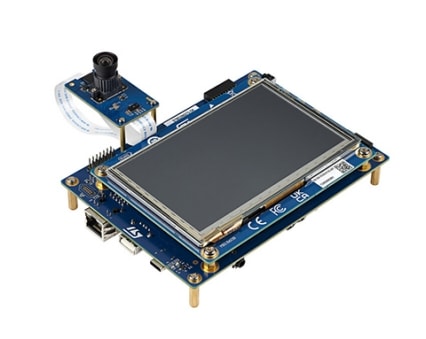 Photograph
Discovery kit
Official product image. See UM3300 for board layout and module references; no hidden component locations are inferred.
Visual gallery
Is this for me?
For embedded developers who want to turn a supported vision or audio model into firmware and eventually a dedicated device. It fills a different role from a Linux AI computer: the firmware, memory plan and deployment tooling are central to the project.
What you can do with it
Make a visible “object present / missing / unknown” display for one marked tray position. Start with a documented camera demo; then add a time-based decision rule and test occlusion. If the pretrained detector does not recognize your chosen part, model/data work comes before the application. Proposed build
What the complete setup costs
ST’s store displayed $220.82 for 1–2 units and “In stock” on 10 Nov 2026. The kit includes camera/LCD hardware and an on-board debugger; a USB cable is not included. Add suitable power/cabling and a development computer if needed. No mandatory subscription is assumed for local tools. Taxes, shipping, regional availability and final checkout can differ. ST store · Kit contents and power
How to start — and what you need to learn
Expect embedded C/C++, flashing/debugging and model conversion. Before building a custom dataset, prove that a supported example compiles and runs with the installed tool versions. Inspect generated memory and operator-mapping reports. First success means a repeatable demo and a measurable pipeline—not a headline compute number.
When another product is a better choice
Choose Pi AI HAT+ for a Pi/Linux integration workflow; choose OAK-D Lite when stereo depth and USB host integration are the main requirements. Choose STM32N6 when learning MCU deployment or moving toward custom embedded firmware is the objective. The included ToF sensor is not equivalent to a dense stereo depth map.
What we know — and what still needs testing
Documentation review: 10 Nov 2026; no board flashing, latency measurement or model validation by Inside AI. Model support, end-to-end accuracy, power and resilience must be measured on the chosen firmware. “Cannot run LLMs” is too absolute: this profile makes no local conversational-model promise and recommends a different platform for that goal.
Architecture
The STM32N657 microcontroller combines a Cortex-M55 with Neural-ART acceleration and on-chip SRAM. External flash/PSRAM extend storage and working memory. The kit also provides a camera module, a 5-inch touch display and STLINK debugging. Hardware overview
In the proposed tray monitor, image capture/ISP → preprocessing → compiled neural network → firmware decision rule → display or external output. Buffers, unsupported operators, postprocessing and display work still contribute to delay. This is a logical processing path, not a claim that all stages run on the NPU or a map of physical PCB traces. AI tooling
Documented capabilities
ST provides starting points for people/object detection, classification, pose estimation, segmentation and audio applications. These are separate example workloads, not a promise that all can run together at the advertised peak compute rate. The camera daughterboard also includes ToF and IMU sensors, allowing a separate range-gating experiment. Example ecosystem · Camera module description
SDKs, APIs & extensibility
Use the STM32N6 AI ecosystem to analyze/convert a supported model, generate target code and integrate firmware. ST Edge AI Core provides a CLI; STM32Cube.AI and Developer Cloud offer related workflows, including remote benchmarking. Framework support does not imply every ONNX graph, precision or operator is accelerated. Inspect the conversion report for the exact model. ST tools and model formats
Check the board evaluation terms, tool license and each model/dataset license separately. A hardware evaluation agreement should not be treated as a blanket ban on tutorial code, or as permission to redistribute every model.
Limitations
The manual warns that a Type-A-to-C connection can limit supply to around 550 mA, close to the demo demand; use the documented power/jumper arrangement. Arduino-header analog inputs are limited to 1.8 V while digital I/O uses 3.3 V. Physical connector compatibility does not establish electrical compatibility. UM3300 power and connectors
A lab kit is not a finished low-power battery product. Measure the whole board with camera and display, not just a neural-network kernel. An occluded tray must not be silently reported as empty; a live bounding box is not proof of reliable missing-part detection.
Privacy & data flow
Inference can be implemented locally without uploading camera frames. Remote benchmark/development services are a separate path: check what model files or data they receive before using them. Our proposed baseline stores event counts and timing, with debug image capture explicitly enabled only for a test. Ethernet availability does not itself imply a cloud dependency.