Orbbec Gemini 336
A detector can name the cup on your desk. The Gemini 336 adds a depth reading to each usable pixel, so a Python application can estimate where the visible surface of the cup sits relative to the camera.
 Drawing
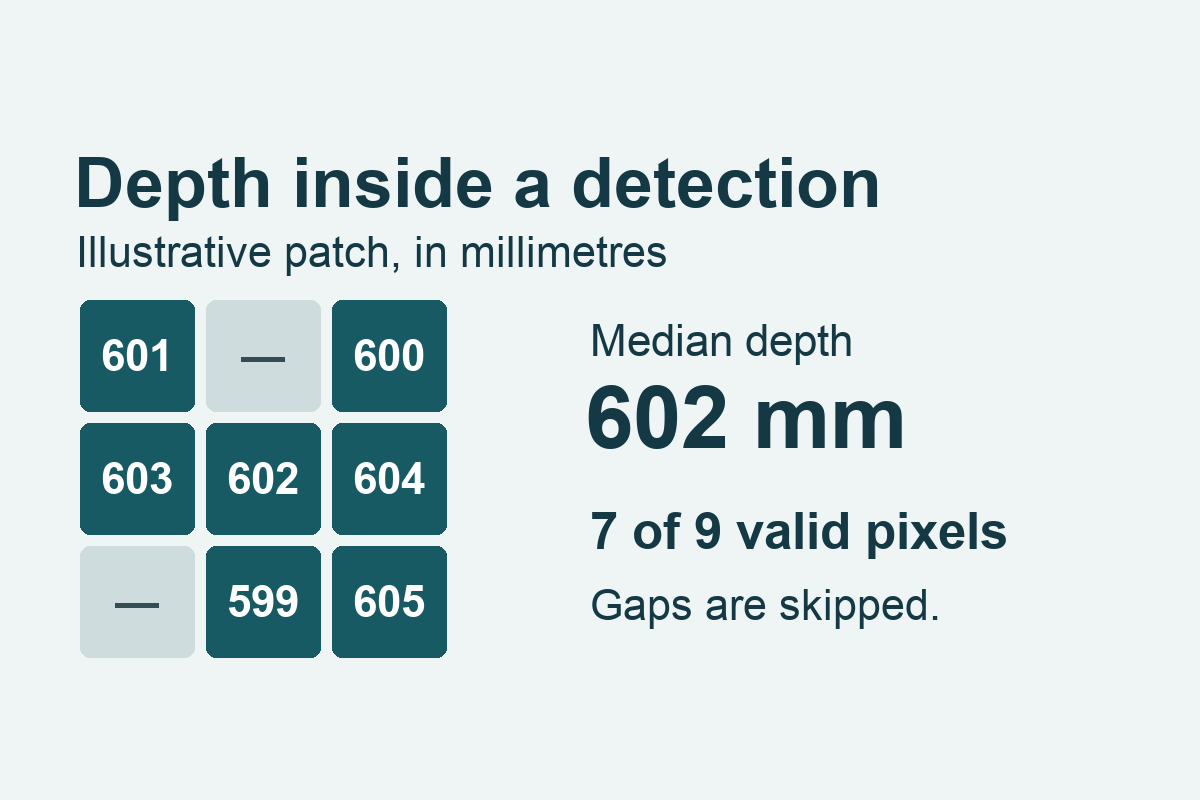
How a box gets a depth reading
Illustrated with invented values. Two gaps are skipped. If the valid pixels mostly show the wall behind the cup, the median will describe the wall.
Visual gallery
Is this for me?
For Python and OpenCV users who can recognize a cup in an image and now want its position relative to a camera. You need a USB host to run the detector. Before a robot arm can use the coordinates, you must also measure how the camera is positioned relative to the arm.
What you can do with it
Put a matte cup on a clear desk and run Orbbec’s detection example. The host should draw a box and show a depth in millimeters. Move the cup closer and watch the value fall. An empty depth region should display N/A. Cup distance guide
What the complete setup costs
Orbbec’s US store lists the IR-pass Gemini 336 USB kit (SKU 100100500) for US$284 on 22 November 2026 and marks it in stock without a quantity. The kit includes a USB-C to USB-A cable, tripod and head. With a suitable computer and USB port already available, the first-year incremental subtotal is US$284 for the kit plus US$0 for local inference. Add a host or compatible data adapter at your quoted price if needed. Tax, shipping, electricity and labor are excluded. Kit and contents
How to start — and what you need to learn
Check host support and install the Python binding. Use a USB 3 data port, confirm both color and depth streams, then run the example with ONNX Runtime and its YOLOv5s model. Learn how the SDK maps a depth pixel to the matching color pixel before interpreting the label. Python setup · Official detection example
When another product is a better choice
The OAK-D Lite can run a compatible detection network in the camera. Choose the Gemini when you want to edit the detector on the host and inspect the individual depth samples behind a result. The alternatives below offer different optics or a different host SDK.
What we know — and what still needs testing
Orbbec documents the depth streams, alignment and examples. Its claimed IR-pass advantage in difficult light still needs a side-by-side trial. Inside AI has no device measurements for depth error, inference speed or end-to-end latency. Camera design · Proposed measurement experiment
Architecture
Two infrared cameras see the scene from slightly different positions. An infrared projector adds texture that helps match points between the views. The MX6800 uses the difference in their image positions to compute depth. USB-C carries depth, color, IR and inertial data to the computer. In the official example the host aligns depth with color, runs YOLOv5s on the color frame and samples the aligned depth values inside each detection box. Camera design · Detection code
Documented capabilities
The SDK can fetch camera intrinsics (the lens and image-center parameters) and extrinsics (the relationship between sensors). AlignFilter registers depth to color, while PointCloudFilter converts depth samples into 3D points. A center pixel with valid depth identifies a point on a visible surface. A box that covers both cup and wall can report the wall’s depth if background pixels dominate. Python SDK · Depth ruler
SDKs, APIs & extensibility
The native C/C++ SDK supports Windows, Linux and selected macOS hosts. Python users can install pyorbbecsdk2 (2.1.3 checked) and import pyorbbecsdk. Select supported stream profiles or replace the host application and model. Firmware modification and loading detection models into the MX6800 are outside this documented workflow. The core SDK uses MIT terms and the Python wrapper Apache 2.0. Orbbec grants a separate license for extension binaries used with its products and prohibits modification, decompilation and reverse engineering of those libraries. Model weights have separate terms. Python package · SDK terms · Wrapper license
Limitations
Depth holes, occluded edges and background pixels can move the reported point. Check matte, dark, reflective and transparent objects separately, and repeat by a sunlit window. Color uses a rolling shutter, so moving cups can change position during readout. USB bandwidth, software alignment and host inference all contribute to delay. Actual detection throughput, depth coverage in sunlight and application latency remain unmeasured.
Privacy & data flow
The documented example reads USB frames and loads a model on the computer. The proposed desk setup keeps processing local and needs no cloud account. Download the model before disconnecting. Saving or sharing color frames, depth maps or point clouds depends on the host application. Example source