Omi CV1 (Consumer Version 1)
Omi CV1 turns recorded conversations into notes. Explore the wearable, its service costs and a first project that lets you review suggested tasks before exporting them.
Illustrative sequence and routes; timing is not measured.
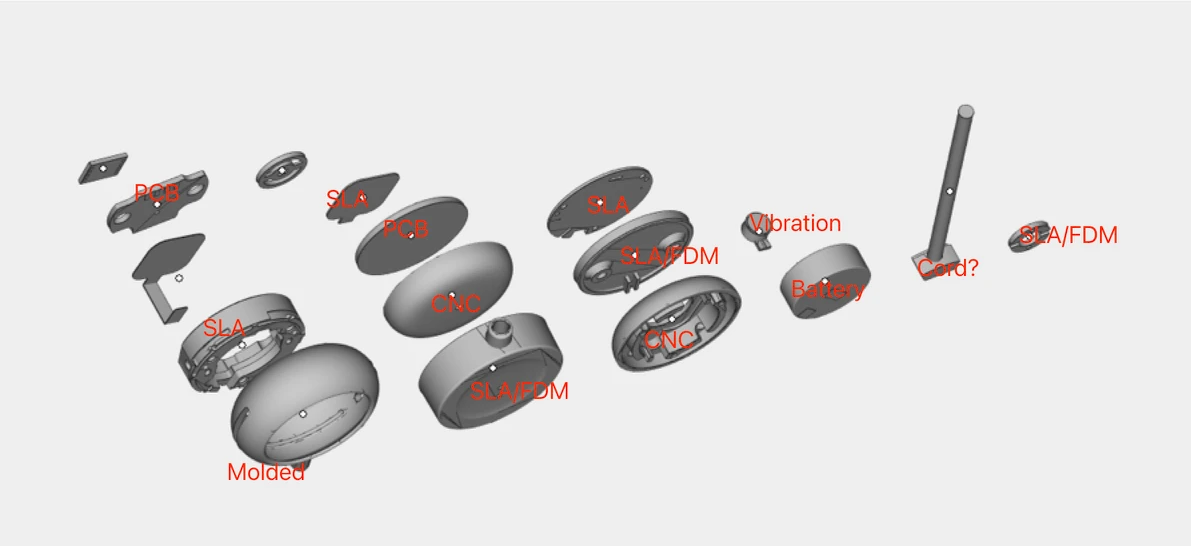
Published CAD rendering, not a CT scan or teardown photograph. Hotspots identify assemblies; chip identity comes from the linked hardware documentation. Animation shows logical stages, not PCB traces or measured timing. Markers below the image are outside this view.
BasedHardware / Omi open hardwareComponent guide
Select a number or a component to follow its role. Inspecting a component pauses the walkthrough.
Electronics assembly
The mainboard brings together the nRF5340, digital microphones, flash, IMU and power circuitry. Individual chips are not identifiable at this scale; use the published schematics for pin-level work.
Is this for me?
For a developer who wants to explore a wearable audio workflow and build integrations around their own conversations and action items. This profile covers Consumer Version 1; a current generic Omi product listing does not by itself establish that exact hardware revision.
What you can do with it
Proposed first result: a review inbox that shows a suggested task beside the conversation evidence, with accept/edit/reject controls before export. A searchable personal conversation index is another possibility. Start with a scripted session containing corrections and unrelated conversation rather than treating every extracted task as a commitment. Task-review build
What the complete setup costs
The official pricing page, checked 10 Nov 2026, lists a generic Omi pendant at $129 and yearly Pro at $269; that page does not confirm the CV1 revision. Free includes unlimited on-phone transcription plus 300 cloud minutes/month. If the seller confirms the listed device is the exact revision you need, device plus free plan is $129 and device plus annual Pro is $398 before tax/shipping. Otherwise the hardware subtotal remains quote-needed. The library previously found a different annual amount on another official page; its calculator still requires the actual plan quote instead of resolving that discrepancy by assumption.
Reuse a compatible phone and development computer. Add optional hosting/model calls and missing accessories; verify checkout contents because the pricing page describes charging accessories inconsistently. Budget with a confirmed quote
How to start — and what you need to learn
First confirm your hardware/firmware revision, record a short agreed session and inspect it in the app. Then use an owner Developer API key to read one conversation and its task candidates; keep credentials server-side. Add writes only after read-only review works. The API has endpoint-specific quotas and list freshness limits. Developer API
When another product is a better choice
Consider NotePin for a more appliance-oriented recording/transcription workflow. A phone-only prototype can test whether your task-review interface is useful before buying a pendant. Open code does not guarantee every consumer firmware or cloud integration can be changed freely.
What we know — and what still needs testing
API access and pricing-page claims were rechecked 10 Nov 2026. Exact CV1 availability, checkout price and service behavior on that revision are unresolved. We have not tested recording gaps, task accuracy or battery life. Review-workflow experiment
Architecture
The CV1 pendant is the capture end of a larger system. Two digital PDM microphones feed an nRF5340 processor; Bluetooth LE connects it to the companion device. Omi’s standard app route sends captured audio into a backend that performs transcription and creates conversation records, summaries and memories. The generative AI is not established as running on the pendant. Omi CV1 hardware and firmware · Hosted processing boundary
CV1 contains 512 MB of soldered SD NAND described as a raw audio ring. That makes storage a separate stage from live Bluetooth transport. It does not demonstrate unlimited offline retention or successful recovery after a long disconnect. Its nRF7002 Wi-Fi chip is currently disabled in firmware, so a chip on the board is not a working direct-to-cloud connection.
Documented capabilities
The documented Omi experience turns conversations into searchable text and generated summaries or action items. A useful distinction is capture versus processing: the conversation API can return a saved transcript with processing_deferred: true when cloud processing is waiting. A completed recording does not guarantee that its summary or tasks exist.
For this profile, the interesting capability is evidence retrieval. Your application can read a conversation’s transcript segments and show the surrounding utterance next to a proposed task. The API’s generated structured fields are another interpretation of the conversation, not ground truth.
SDKs, APIs & extensibility
There are two developer entry points. The Developer API reads the owner’s saved conversations, memories and action items using a scoped credential. A backend can build an export or review UI around those records without modifying the pendant. It does not expose an audio-download surface.
The device SDKs operate closer to capture. Omi documents Python, Swift and React Native Bluetooth paths; their transcription backends differ. The Python guide uses Deepgram, while the Swift guide documents local Whisper. Verify the chosen SDK, CV1 firmware and audio format together before promising an offline application. Firmware and hardware design files are open, but changing a hardware design is a different project from adding an API integration.
Limitations
This entry covers current consumer hardware. DevKit 2 is no longer sold and its removable-card design must not be copied into a CV1 specification. Regional stock, shipping and current plan allowances still need checking with the maker.
A voice pipeline can lose meaning at several places: clothing noise at the microphone, a link interruption, incorrect transcription, uncertain speaker attribution or a summary that misses a correction. None of our proposed tests have been run on CV1 hardware. Open-source availability also does not imply a supported self-hosted production service; Omi documents local backend development while stating that a production self-hosting guide is not supported. Service scope
Privacy & data flow
Use a rehearsed conversation with consenting participants for the first build. Give them a clear start and stop signal and use fictional names, dates and tasks. Keep the pendant buffer, phone/app copy, hosted conversation, third-party transcription service and your own export as separate entries in the data-flow map.
The proposed review tool should request only the conversation access it needs, keep credentials on its server and avoid importing location or unrelated personal records. Deleting a hosted conversation does not by itself prove that your exported JSON or another service’s copy is gone. Test deletion and retention on your own storage separately; a local SDK transcription path needs a network check before being described as private or offline.