MyoWare 2 Muscle Sensor
Flex a muscle and watch a light brighten. Three skin electrodes and a battery-powered sensor make muscle activity visible. For a gesture interface, the next question is whether the same flex gives a repeatable signal after you put the sensor on again.
 Drawing
How a flex becomes a light level
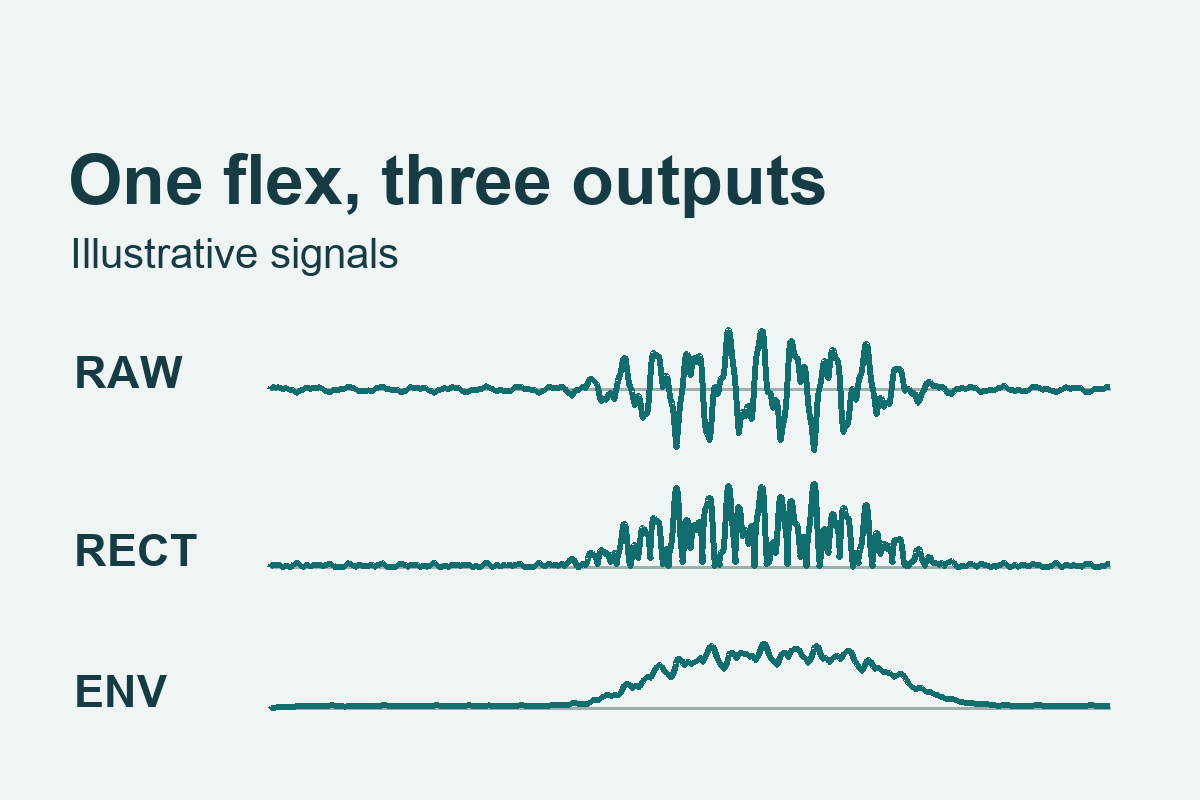
An invented signal shows the same flex at three analog outputs. Time runs left to right. The vertical scales are independent, and the traces are centered for illustration. ENV is the signal that drives the light.
Visual gallery
Is this for me?
For makers and interaction designers who want one muscle to act as a control input. Surface electromyography (sEMG) picks up electrical activity through the skin. The output gives a relative indication of activation. It cannot tell you how many newtons you exerted, which gesture you intended or whether a muscle is healthy.
What you can do with it
Use the rechargeable Power Shield and its single ENV light. Watch the light at rest, flex gently, then relax. Look for the brightness to rise and fall with the action. This first observation needs no code. Build the flex light
What the complete setup costs
With a compatible USB-C charging cable and 5 V source on hand, the first session costs US$68.85: $42.95 for the sensor, $15.95 for the Power Shield and $9.95 for ten disposable electrodes. Twelve separate fittings use 36 pads. Four ten-packs bring the first-year subtotal to $98.70, assuming the remaining pads can be stored and used as directed. Add a quote for any missing charging equipment. There is no required subscription, host computer or cloud service for the light. Prices exclude tax, shipping, electricity and labor. Board · Shield · Electrodes
How to start — and what you need to learn
Charge the detached shield first. Learn the MID, END and REF markings using the manufacturer’s placement illustrations. Good electrode contact and a consistent position matter more to this first experiment than software setup. Fitting and hookup guide
When another product is a better choice
One MyoWare sensor suits one local control, such as brightening a light when you flex. If your question is which of several muscles activated first, look at the Ganglion and Cyton cards below. They record multiple channels together and bring their own host software and accessory requirements.
If your experiment needs heartbeat intervals during movement, the Movesense HR+ guide covers chest ECG and motion recorded by the same wearable.
What we know — and what still needs testing
The analog stages, gain adjustment and shield indicator are documented. Inside AI has not measured response delay, repeatability after refitting, false triggers during movement or battery runtime. The repeatability trial is a proposal. Technical specifications · Proposed test
Architecture
Two sensing contacts pick up a small voltage difference over the target muscle. A third contact provides a reference. The analog front end amplifies and filters the signal to produce RAW. Full-wave rectification gives RECT, which represents the magnitude of both halves of that waveform. Smoothing gives ENV, a slower voltage that follows the overall activity. The Power Shield supplies battery power and displays ENV as LED brightness. Sensor and signal taps · Power Shield indicator
From muscle activity to light
Drag the slider to change the strength of a simulated flex. Each trace shows the same half-second, starting at rest.
RAW swings around a reference level. RECT folds both halves upward. ENV smooths those peaks. Its rightmost point sets the lamp brightness, relative to the same point at full simulated contraction. The traces use fixed scales as you drag. All values are generated in your browser, without sensor readings.
Documented capabilities
Use the envelope to see a flex or as the input to a simple switch. Use the raw output when you want to design your own processing on a separate recorder. RAW, RECT and ENV describe three forms of the same channel. Capturing a second muscle at the same time requires another channel.
SDKs, APIs & extensibility
The base board has an analog output and an adjustable envelope gain. A microcontroller with a compatible analog-to-digital converter (ADC) can sample the voltage. The host sets the sample rate and implements thresholds or a trained classifier. The manufacturer provides an MIT-licensed Arduino library. SparkFun documents the hardware design-file restrictions separately. Arduino library · Software license · Hardware files
Limitations
Placement, contact, movement and gain can change the apparent response. A saturated envelope can make different flexes look alike. Repeat the rest-and-flex check after each fitting before reusing a threshold. The manufacturer specifies the board for nonmedical use. During the wearable demo, keep USB disconnected and run from the shield battery. Remove the shield from the sensor before charging it. Hookup and power precautions
Privacy & data flow
In the battery-and-light build the signal travels from the electrodes through the analog circuitry to the indicator. This setup has no recorder, network connection or account. Adding a logger or a computer changes who can retain or share the readings.