M5Stack Module LLM Kit (K144)
Build a small local text or speech service. K144 is listed at $79.90 but currently unavailable; its local chat API does not support function calling.
Illustrative sequence and routes; timing is not measured.
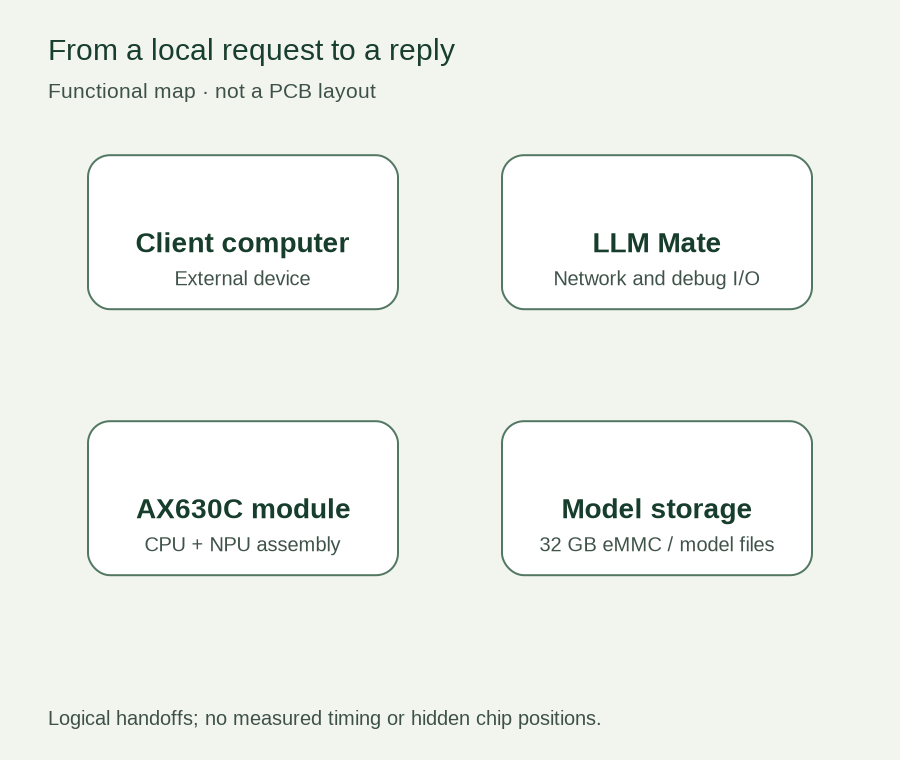
Inside AI functional illustration based on manufacturer documentation. Positions group roles, not physical component locations. Arrows show logical handoffs, not circuit traces or measured timing. External devices and optional stages are labeled.
Inside AI illustration; manufacturer documentationComponent guide
Select a number or a component to follow its role. Inspecting a component pauses the walkthrough.
Client computer
External computer sends a short request and displays the generated reply. It does not perform the module inference.
Is this for me?
For makers comfortable with a terminal who want to give an existing device local text or speech capabilities without sending every inference request to a cloud service. Best treated as a constrained embedded inference service. Readers seeking large-model reasoning, arbitrary model loading, or a ready-made tool-calling agent should not choose it on API compatibility alone.
What you can do with it
First observable result: from an existing computer, list the kit's installed local models and receive one short text reply from its local HTTP API. This is based on official API examples; we have not executed them. Keep speech and physical actions out of the first milestone.
Start with the connection guide, API installation, model listing, and chat example. After service/model installation, a successful model-list response must include an AX630C-compatible model; use its actual returned ID for the chat request. A JSON response without generated text is not completion of this milestone.
Proposed next build: a local phrase-rewriting endpoint for a robot's display. Supply a short fixed instruction and input phrase, display the reply, and retain a deterministic fallback. This does not rely on unsupported function calling. A speech version can later add the separate ASR and TTS services.
What the complete setup costs
Checked 2026-11-12: official kit store lists US$79.90, SKU K144. Its product data endpoint reports price 7990 and available: false, including the sole variant. This is a listed price for an unavailable kit, not a checkout or delivery promise.
For the local HTTP starter, reuse a computer, local Ethernet router/switch, and suitable USB power. Budget separately for a USB data cable and Ethernet cable if not already owned; the kit's includes list does not include these. Adequacy of the chosen USB supply/cable should be confirmed before purchase. An M5 Core host is optional for this computer-controlled route, but required for examples specifically using an M5 host. A camera, enclosure, and SD card for a particular recovery workflow are optional additions, not included capabilities of the starter.
First-year formula: $79.90 listed kit + missing cable/power costs + any missing computer/network equipment + $0 required cloud inference subscription for the documented local route. Conditional incremental subtotal is $79.90 only if all supporting equipment is reused and the kit becomes purchasable at that price. Otherwise the total is unknown; accessory and host quotes were not verified. No monthly/annual subscription or trial is assumed. Custom cloud fallback, external hosting, or paid model services would add their own usage charges and are excluded. Tax, shipping, electricity, internet service, and labor are excluded.
How to start — and what you need to learn
Use the official ADB connection instructions first; establish a device shell before installing anything. Connect the Mate as documented, establish Ethernet, then follow the device-specific APT repository and API instructions. Install compatible runtime/service/model packages and restart the API service after adding a model. Query /v1/models before /v1/chat/completions. Avoid copying the AX650 model from the generic curl example onto AX630C hardware.
Requires USB troubleshooting, basic Linux package/service commands, local IP networking, and optionally Python. Downloads need internet during setup; offline inference is a later property to verify after provisioning. The documented default login is shared, so change it before broader network use and keep the API on a trusted LAN. No installation-time estimate or successful setup is claimed.
When another product is a better choice
Choose Jetson Orin Nano Super when the goal is broader Linux/CUDA experimentation and heavier models; its host, storage, power and cost tradeoffs differ. Choose XIAO ESP32S3 Sense with deterministic commands if all you need is a few fixed actions. Choose K144 for investigating the usefulness and limits of compact local language/speech services, subject to restocking and tests below.
What we know — and what still needs testing
Documented: local HTTP endpoints, serial/ADB access, separate service/model packages, onboard microphone and speaker, and the kit contents. Manufacturer claims, not measured here: 3.2 TOPS INT8 and approximately 1.5 W module full-load consumption; this is not a measured complete-system power budget. Editorial proposal: phrase rewriting and any robot integration. Unknown: current restock date, output quality/latency, concurrent service capacity, and suitability of custom model conversion.
Architecture
For the first project: computer sends text over the LAN → Mate Ethernet interface → local HTTP/StackFlow service → AX630C-compatible model on the module → generated text returns to the client. The module has dual Cortex-A53 CPU cores, an NPU, 4 GB LPDDR4 split between system and acceleration use, and 32 GB eMMC. The Mate supplies additional connection/debug interfaces; it is not another AI processor. Store contents and specifications are documented on the kit page.
The StackFlow repository describes an optional voice pipeline: onboard audio acquisition → wake-word detection → speech recognition → language model → speech synthesis → speaker. These are software stages, not six separate physical chips. The MSM421A microphone, AW8737 audio driver and speaker are documented in the module reference. No hidden chip locations are asserted.
Documented capabilities
Documented: local model listing and text generation through HTTP, separate ASR/TTS services, Arduino/UiFlow control, and serial/ADB access. Kit K144 contains the Module LLM, Module13.2 LLM Mate and two FPC cables. A display host and camera are not included.
Start with a single text reply before attempting a voice assistant. The phrase-rewriting display project is proposed, not a supplied complete application. Build guide
SDKs, APIs & extensibility
Arduino/UiFlow libraries expose module control; StackFlow also provides JSON interfaces and an optional OpenAI-compatible HTTP service. The official framework describes an MIT license, but that does not license every model, vendor binary, hardware drawing or photograph. Individual model and SDK terms require separate review. AXERA-specific model preparation is required; arbitrary downloaded model weights are not directly interchangeable.
The chat API reference explicitly marks function_call and audio output unsupported on that endpoint. Separate speech services exist. Do not equate format compatibility with full OpenAI feature parity. The local API documentation says inference stays on the device; package/model downloads still contact upstream services. Added application logging, forwarding or cloud fallback can change the privacy boundary. Offline behavior and network exposure have not been packet-tested.
Limitations
The official K144 product feed reported unavailable on 12 Nov 2026. No restock date is verified. The chat endpoint does not support function calling or direct audio output; separate speech services do not change that endpoint contract. AX630C requires compatible compiled model packages. The 4 GB memory is split between system and acceleration use, and is not 4 GB of general application RAM. Reply quality, latency and concurrent speech performance remain unmeasured. Unrun tests
Privacy & data flow
The documented HTTP service runs models on the module rather than forwarding requests to OpenAI. Model/package installation needs upstream downloads. Keep the first client on a trusted LAN, change documented default credentials, and examine logging and outbound traffic before using private text or audio. Cloud fallback and third-party application forwarding are separate choices; we have not packet-tested offline behavior.