Infineon PSOC Edge E84 AI Kit
Build a camera-free radar gesture input and see push or circle scores in a serial terminal. Use a separate profiling example to find where an accelerated model spends its time.
 Drawing
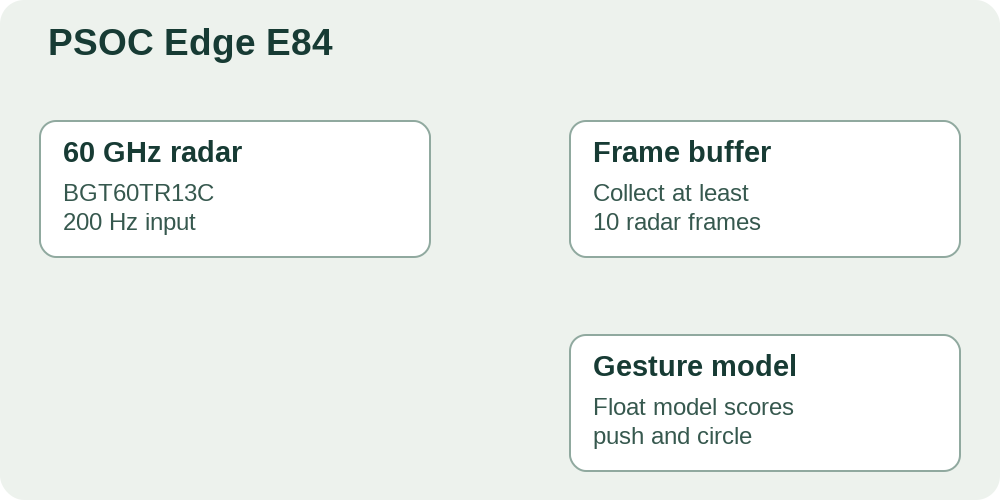
Radar gesture signal flow
Original functional diagram of Infineon’s radar example. The boxes represent processing stages. See the kit guide for board photographs and component locations.
Visual gallery
Is this for me?
For embedded C developers who want to turn short-range sensor activity into local events and are comfortable flashing firmware and reading logs. Choose it for radar, sensor fusion or comparing MCU compute domains. It takes a compiled firmware build to change the behavior.
What you can do with it
Run Infineon’s DEEPCRAFT Radar Model Example on KIT_PSE84_AI. Open the KitProg3 serial port at 115200 baud, 8N1. With the radar oriented as in the example and about 60 cm away, try a push and then a circle. Look for the startup banner followed by plausible class scores. Build guide
What the complete setup costs
DigiKey US listed KITPSE84AITOBO1 at US$72.57 on November 15, 2026. The first radar build reuses a compatible computer and USB data cable, uses the board’s built-in KitProg3 and radar, and has a US$0 required software subscription. First-year incremental subtotal is US$72.57, or US$77.57–87.57 with a US$5–15 editorial allowance for a data cable. A new computer needs its own quote. Camera and extra measurement hardware are unnecessary for this starter. Excludes tax, shipping, electricity and labor. Exact kit listing
How to start — and what you need to learn
Install ModusToolbox, select KIT_PSE84_AI in Project Creator and flash the official C example through J1. The project contains Cortex-M33 secure, Cortex-M33 non-secure and Cortex-M55 builds. Start with the default Debug configuration. Infineon documents a GNU Arm 14.2.1 Release build issue. Custom model work adds data collection, training and a compatible firmware integration.
When another product is a better choice
Start with the STM32N6570-DK if the first result should be a camera pipeline. Pick Nordic Thingy:53 if the first result should be a portable TinyML sensor prototype with its existing wireless and enclosure workflow. E84 gives you the onboard radar and two documented profiling paths.
What we know — and what still needs testing
Hands-on testing: none yet. Infineon documents the float radar starter and a separate profiler. The starter alone does not verify NPU use. Gesture reliability across people and distances, end-to-end response and work moved to each accelerator still need measurement. Proposed profiling experiment
Architecture
The XENSIV BGT60TR13C radar captures a 200 Hz input stream in the sample firmware. The firmware buffers at least 10 frames per inference invocation and runs a floating-point classifier. Its gesture scores leave the board over the KitProg3 virtual serial port for a PC terminal. The acquisition frequency describes the input; the inference and terminal rates depend on the run. Design notes
The high-performance domain pairs Cortex-M55 and Ethos-U55; the low-power domain pairs Cortex-M33 and NNLite. Keep the radar demo and the ML Profiler reference projects distinct. The profiler supports configured models on each domain and can report CPU/NPU cycles. Kit guide Profiler
Documented capabilities
The official radar starter prints scores for gestures such as push and circle. The kit also has microphones, motion, magnetic, pressure, temperature and humidity sensing, plus Wi-Fi and Bluetooth. A wake-on-event camera pipeline is a proposed design. It would need separate event gating, camera integration and whole-board power measurements. Check the kit revision before relying on the included camera connector. Kit guide
SDKs, APIs & extensibility
Use ModusToolbox and the board support package for C firmware, sensor settings, UART output and debugging. The radar starter accepts generated model.c and model.h files. Larger models or different capture rates can require changes to the frame feed. Check each example’s Cypress terms before redistributing code. The optional DEEPCRAFT Studio path requires an account and lists 3,000 training compute minutes a month on the free tier. Its terms list production deployment on Infineon MCUs and NPUs as free. Check account requirements for any optional package you choose. Studio documentation Licensing
Limitations
The published radar starter accepts unquantized models. Verify acceleration using a compatible model and recorded CPU/NPU counters. The profiler ships with different default models for the two domains, so first use them to validate tooling, then use a matched workload for comparisons. Infineon records a GCC Arm 14.2.1 Release build issue related to Helium instructions and identifies armclang as an alternative. Radar starter Profiler
Privacy & data flow
The starter samples radar on the kit and sends gesture scores over USB serial to the attached computer. Its documented path uses no camera or cloud inference. The terminal can retain logs if configured. Optional DEEPCRAFT cloud training sends data chosen for training to the provider; verify data and retention terms before submitting identifiable recordings. No network or retention audit has been performed.