Arduino Nicla Vision (ABX00051)
Can a camera tell whether the right object is actually at the inspection point? Nicla Vision lets you pair a local image score with one distance reading. Start by viewing a frame and reading millimetres over USB, then test the two signals together.
 Drawing
When a package should trigger an event
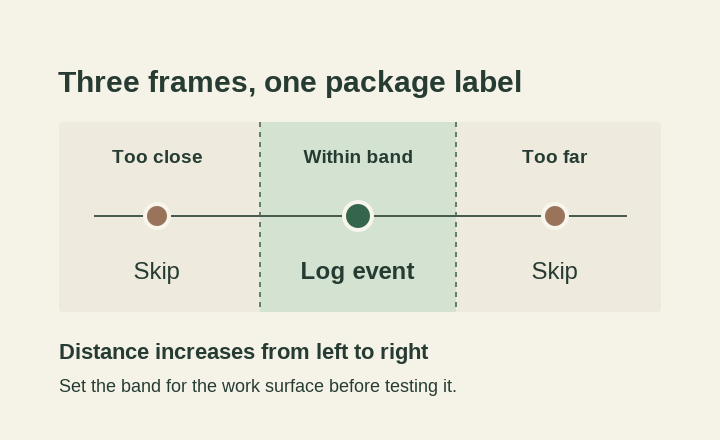
Three hypothetical frames have the same package label. Only the middle range passes the proposed rule. Set the window for the fixture and measure both false alerts and misses.
Visual gallery
Is this for me?
For MicroPython developers building a fixed inspection station where an object should count only inside a known distance band. The camera and ranger share a board, so you can try the rule with a laptop and cable before choosing a mount or building a wireless node.
What you can do with it
Hold a flat card in front of the camera. Bring up a live image in OpenMV IDE, then run the onboard range example and move the card between two marked distances. Look for a responsive image and an orderly change in millimetres. Next, try printing a label only when the image score and distance both qualify. Board examples · Build guide
What the complete setup costs
US$52.13 for ABX00051 in the Arduino US store on 19 Nov 2026 ($80.20 crossed out; available to order, quantity undisclosed). With a compatible computer and a micro-USB data cable already on the bench, year one is $52.13 + $0 required services. If buying the cable, allow $5–10, for $57.13–62.13 with the same computer. Price a missing computer separately. USB supplies bench power. A battery or mount is optional. Tax, delivery, electricity, labour and optional training or hosting are excluded. US listing
How to start — and what you need to learn
Install OpenMV IDE, back up any files on the board, and load the Nicla Vision firmware from release 5.0.1. Use its camera and range examples separately before combining them. You will need basic Python, a repeatable target position, and familiarity with model input shapes and score thresholds for the classifier. IDE setup · Reference release
When another product is a better choice
A single distance works when a fixture keeps the target within both fields of view. For spatial separation across the scene, OpenMV AE3 offers an 8 × 8 range grid. For on-board visual feedback and selectable built-in models, see HUSKYLENS 2.
Detecting a moving card with GenX320 · Keep the marked near and far positions from the range-gate project. Move the card through each position, then hold it still. For both cameras, record when the detector first fires and whether an empty scene triggers it.
The Prophesee GenX320 kit for STM32 reports changes in brightness at individual pixels. A moving edge can produce events and then go quiet when the card stops. Start with the kit’s event viewer on a separately supplied STM32F746G Discovery board. Replace the RGB image score with an event count over a short interval and tune the threshold on fresh recordings. To keep the original distance gate, add a range sensor and pair its readings with the event timestamps. Inside AI has not tested this hardware comparison.
Simulated data · Hardware experiment untested
When does a moving card trigger the detector?
Follow the printed card to the right. Its edges brighten some pixels and darken others.
Amber · brighterBlue · darker
- Current window
- 64 events · Triggered
- First trigger in sequence
- 80 ms
Each 20 ms window compares two synthetic images and counts pixels that changed brightness. The detector triggers when the count reaches the threshold. Both views share a clock. A real GenX320 reports individual changes as they occur. How event sensing works
What we know — and what still needs testing
Arduino documents the camera and ranger separately. The tagged Nicla build enables TensorFlow Lite Micro and includes a person model. Their combined trigger is a proposed integration. No Inside AI hardware run has established latency, free heap or any reduction in false triggers. Firmware target · Included models · Placement experiment
Related experiment · Use the side view in the DIGIT and Nicla Vision slip replay to follow the coin against a mark on the gripper. If they move together, the coin is still held even when the tactile alarm fires. Both views use simulated data. The hardware experiment is untested.
Architecture
In the proposed node the GC2145 supplies a frame. On the M7, the application selects the region of interest, prepares the image for the model’s input shape and derives a class and score. In parallel as a logical input, the VL53L1CB measures reflected infrared light and reports a distance over internal I²C bus 2. The application pairs recent readings by timestamp, checks the score and range window, then prints a compact event over USB. The host can store events. Radio delivery is an optional application change. Camera and range interfaces
When does a package become an event?
Try one frame at a time on an imagined packing station. Each example starts with the trigger armed. The scores, distances and cutoffs illustrate a proposed design.
How the inputs are produced
Image classifier
The GC2145 supplies a frame. The proposed application timestamps it, prepares the model input and scores it locally on the M7. Package detection needs a compatible package-trained model. The bundled person model has different labels. OpenMV 5.0.1 classification example
Distance sensor (ToF)
The VL53L1CB uses time of flight to return one distance in millimetres. OpenMV reads it over internal I²C bus 2. Each reading needs its own timestamp. A hand in front of the package can supply the distance. OpenMV Nicla Vision board guide
Awaiting hardware tests. OpenMV documents the camera and ranger. Inside AI has not tested a package model, timing alignment, these cutoffs or re-arming on hardware. A comparison with vision alone must count both false alerts and missed packages.
Documented capabilities
The same board carries an IMU, microphone and Wi-Fi/BLE. The USB starter uses only the camera and ranger. OpenMV’s bundled person model offers a starting score for a person-in-range experiment. A packaging station needs its own package classes and representative examples. Hardware · Bundled models
SDKs, APIs & extensibility
OpenMV 5.0.1 runs MicroPython on the M7. The board build enables TensorFlow Lite Micro. Load a compatible .tflite model with ml.Model, and call predict on an image input as in OpenMV’s tagged example. Check operators, tensor dimensions and working memory on the board; arbitrary exports can fail to load. Arduino documents Edge Impulse as one account-based training/export route. An existing compatible model can be supplied directly. OpenMV describes most firmware code as MIT, with GPL, third-party and proprietary exceptions. The relevant component and model terms apply to redistribution. Hardware design-file reuse terms were not established here. Classification source · Optional training · Licensing
Limitations
The ranger returns one distance for its field of view in this example. A foreground hand may supply the distance while a package farther away supplies the image label. Fix the mounting geometry and test this mismatch. Reflective wrap, dark stock and invalid or stale distance samples belong in the test set. The assembled unit’s microphone revision is also unresolved. Arduino’s datasheet features table lists MP34DT06JTR, while its microphone section and the US store name MP34DT05. ABX00051 datasheet · US store
Privacy & data flow
In the proposed USB-only deployment, frames and range checks are processed on the board. OpenMV IDE can display camera frames on the attached computer during development. For event-only use, disable image preview/streaming, leave networking and audio capture off, and log just time, label, score and distance. Sending frames to an optional hosted trainer or saving them on the host creates separate copies. Traffic and retention have not been audited.