Build a repeatable microphone test bench
Proposed build · Capture first, add direction logging, then compare one recognizer.
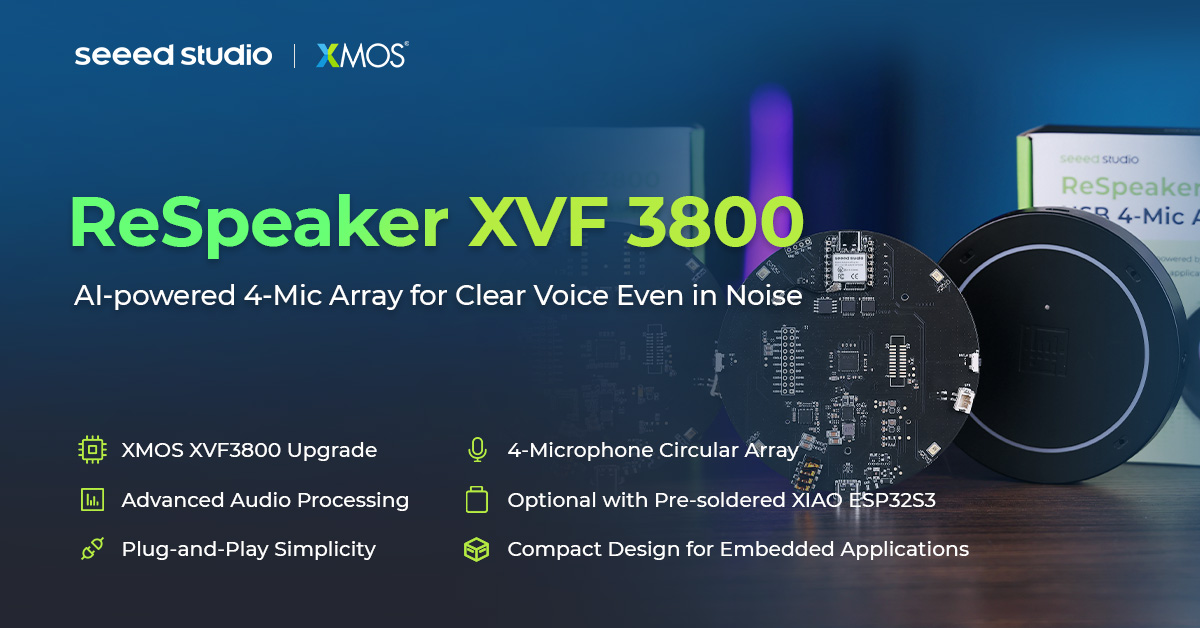
Device profile · reSpeaker XVF3800 USB 4-Mic Array with Case ↗This is a proposed workflow. Follow the linked official setup, then use the checks below to decide whether it works on your hardware.
Outcome and full cost scope
USD, 11 Nov 2026: USB 4-Mic Array with Case, SKU 114993701 is $59.90. This is the case bundle without a XIAO host; no speaker is assumed included. Exact stock and delivery remain unverified.
First-year USB recording bench: $59.90 + $5–15 editorial USB-C data-cable allowance + $0 required hosted service = $64.90–74.90, reusing a compatible computer and playback headphones/speakers. If the cable is already owned, incremental hardware is $59.90. Confirm box contents; a new host needs a separate quote.
A speaker and suitable playback/reference wiring are additional requirements for the optional echo-cancellation test if you cannot reuse them. Local transcription needs adequate host compute and separately licensed model/software; a new Raspberry Pi also needs power/storage. These are not included in the recording subtotal. Cloud transcription/LLM/TTS and hosting are optional usage costs; no plan, annual discount or trial is assumed. Excludes tax, shipping, electricity and labor.
1. Record before configuring
Connect over USB and follow the host setup. Write down device ID, firmware and reported sample format. Record and replay the same consented phrase at a marked position; avoid automatic host input changes during the trial.
2. Inspect the control plane
Use the official Python guide to read VERSION and timestamped DoA/VAD values. Check angles beyond 255° to catch incorrect byte decoding. Add a simple live direction display only after the log is sensible.
3. Add recognition as a separate stage
Feed the recordings into one fixed local recognizer on the reused host; keep model, language and decoding settings identical. For Mandarin, report character error rate and transcription failures. Do not call different models or gain settings a hardware-only comparison. Follow the room test.